ELISA plates are commonly used in health analysis and testing for the detection of antigens in samples by spectrophotometry.
The microplate readers o ELISA spectrophotometers are calibrated and verified with microplates. Thus, with ELISA plates -also called standard plates or microplates- it is possible to calibrate the wavelength scale and the photometric scale of the equipment.
In this entry we talk about ELISA plates, as well as about the information that gives them their name, their uses and some examples of regulations and standards that refer to this technique and the use of microplates.
ELISA technique
Enzyme-linked immunosorbent assay is called ELISA technique. The term comes from the acronym in English, Enzyme-Linked ImmunoSorbent Assay.
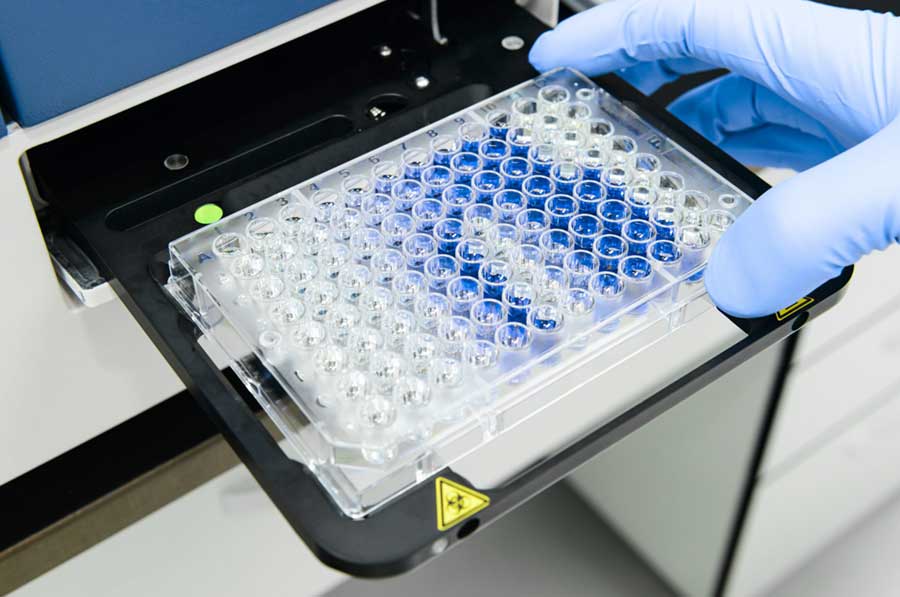
Using spectrophotometry, this technique allows the detection of an antigen through an enzyme-linked antibody. For this, usually, use is made of some detectable product, such as the change in color, which would make it possible to measure the antigen. That is, an immunoenzymatic reaction with addition of substrate and colorimetric quantitative determination.
Measuring instruments
ELISA microplates
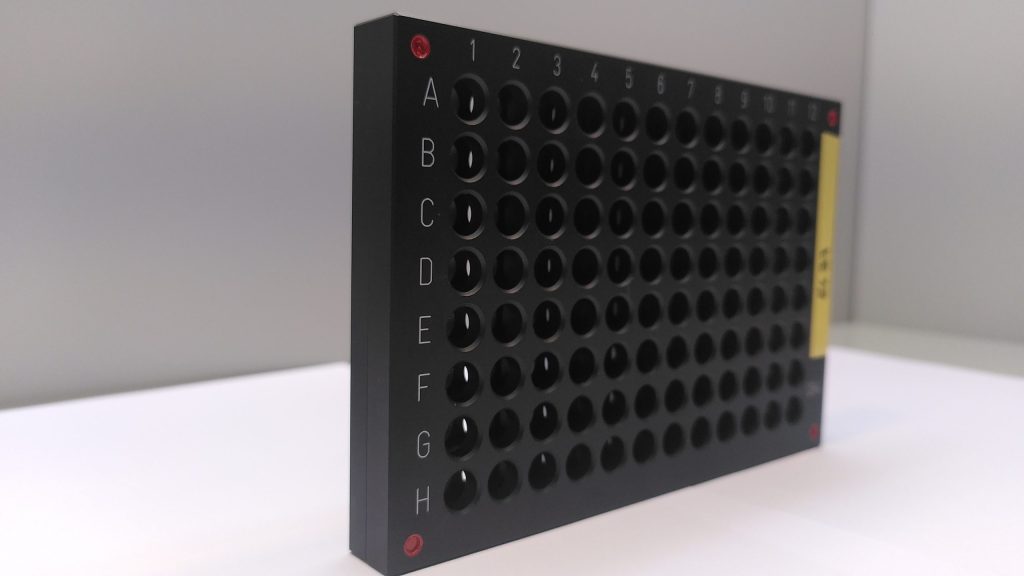
microplates or pattern plates are used for internal verification or calibration of ELISA microplate readers or spectrophotometers.
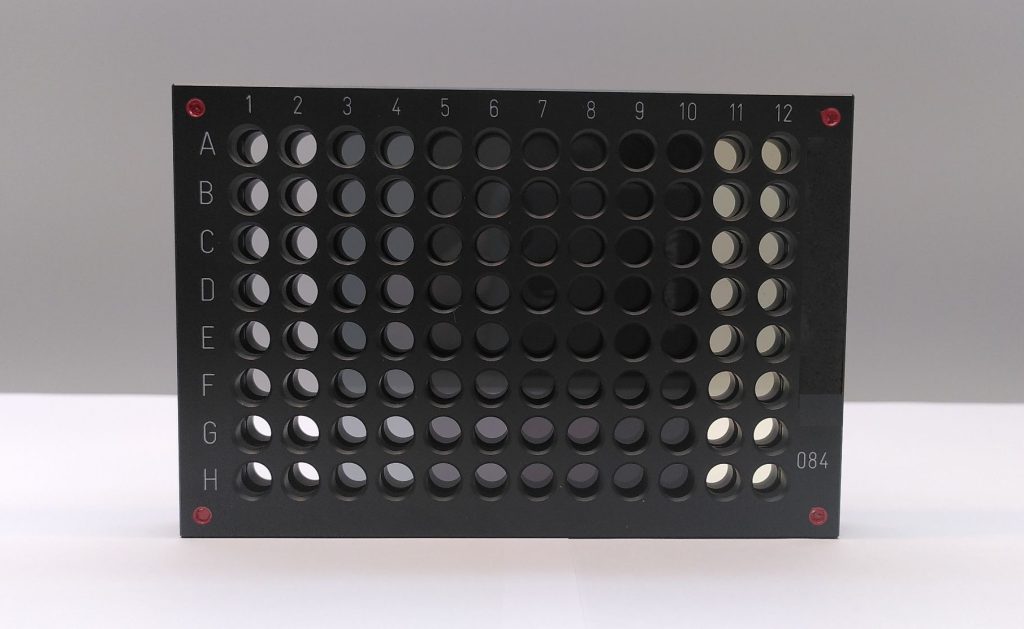
These plates usually have a rectangular shape and approximate dimensions of 12.5 cm by 8.5 cm. Another characteristic of the microplates is that they contain 96 wells, distributed in 8 rows by 12 columns. Specifically, each of the columns represents a specific absorbance value at different wavelengths. Also, sometimes, there are plates with columns that are used for the calibration of the wavelength scale; these contain a holmium oxide filter with known absorbance peaks.
Using these standard plates, ELISA spectrophotometers or microplate readers can be calibrated in absorbance or wavelength.
As regards the absorbance calibration, or photometric scale calibration, allows to measure the accuracy or the correction that the equipment presents with respect to the absorbance values for different wavelengths. These plates contain 5 or 6 neutral density filters with different absorption values (from 0.2OD to 3.5OD) arranged along the columns.
On the other hand, with some models of microplates, the wavelength scale calibration. These are microplates that contain filters in their columns, usually holmium oxide, with narrow absorption bands for different wavelengths. These filters present absorbance peaks from 240nm to 650nm in the UV-Visible range. Thus, through this calibration, the ability of the monochromator component of the spectrophotometer to separate a specific wavelength from the rest of the illumination spectrum can be evaluated.
ELISA spectrophotometers, microplate readers
The ELISA spectrophotometers or microplate readers are optical equipment that, like UV-Visible spectrophotometers, measure the amount of light that a sample transmits or absorbs at different wavelengths.
This type of instrument is composed of a light source, a monochromator and a detector.
Regarding the illumination system, it is worth saying that microplate readers usually work in a range that goes from 400nm to 700nm. It is common for them to have a tungsten source for the visible zone, although there is also equipment that reaches the ultraviolet range.
As for the monochromator, it allows the separation of the light spectrum and provides an energy beam at a specific wavelength. When wavelength is critical or affects the measurements being taken, this component must be calibrated—that is, calibrated at a specific wavelength. It is possible to calibrate different wavelength points across the entire range of the instrument.
Finally, the detector transforms the signal it receives (photons) and converts it into an electrical signal. The intensity of the electrical signal is recorded by a system that provides absorbance or optical density values.
Uses and regulations
Uses of the ELISA technique
The wide variety of tests and analyzes that can be carried out with this technique makes us understand the diversity of standards and regulations that indicate the convenience of using methods and procedures that make use of it.
To give some examples, the ELISA technique is used for the diagnosis of diseases such as cancer, Alzheimer's, hepatitis B, the presence of HIV or COVID-19. Thus, using this technique, for example, tests for the detection of the TAU protein can be performed; P-TAU protein; β-amyloid protein 1, 42; or the analysis of the presence of IgM and IgG antibodies against the SAR-CoV-2 virus.
For its part, in the field of veterinary medicine it is possible to detect antibodies, for example, against bluetongue, Brucella, enzootic bovine leukosis, swine fever, the gE glycoprotein of Aujeszky's disease or the pathogenic prion protein of transmissible spongiform encephalopathies.
In addition, the ELISA technique is also used for the detection of allergens in food for human or animal use. The quantification of gluten, egg, β-lactoglobulin, soybean, peanut or almond, among others, are examples of its use in this field.
Examples of regulations
As we have explained above, there are various rules and regulations that specify methods for the detection of antigens, protocols for the standardization of materials, and analysis procedures using this technique. It is the case of Regulation (EU) No. 206/2010 of the European Commission. This regulation establishes lists of third countries, territories or parts of third countries or territories authorized to introduce certain animals or fresh meat into the European Union and the veterinary certification requirements. In this sense, this regulation indicates the use of the ELISA technique, for example, in analysis procedures for bluetongue (FCO) or foot-and-mouth disease (FMD), among others.
Another regulation that makes the use of ELISA plates explicit is, for example, the Regulation (EU) No. 1064/2012 of the Commission. This indicates that to carry out rapid diagnostic tests, immunoassays based on an ELISA microplate can be used for the detection of PrPRes resistant to proteinase K with monoclonal antibodies (Prionics-Check LIA test) for monitoring BSE in bovines.
In addition to legislation or regulations, there are standards that establish test methods for the detection of certain antigens. To give an example, the norm UNE-EN ISO 19020: 2008 establishes a horizontal method for the immunoenzymatic detection of staphylococcal enterotoxin in food products.
Another example in the case of allergen detection by immunoassays (ELISA) is the Standard UNE-EN 15633-1:2009, that as indicated by AENOR, «provides the general scheme of qualitative and quantitative methods aimed at the determination of allergens and allergenic ingredients in food products. For this, antibody-based methods are used, specifying the general guidelines and performance criteria aimed at the detection and quantification of proteins that serve as markers of the presence of food or food ingredients that cause allergic reactions.»
Laboratorios Eyco
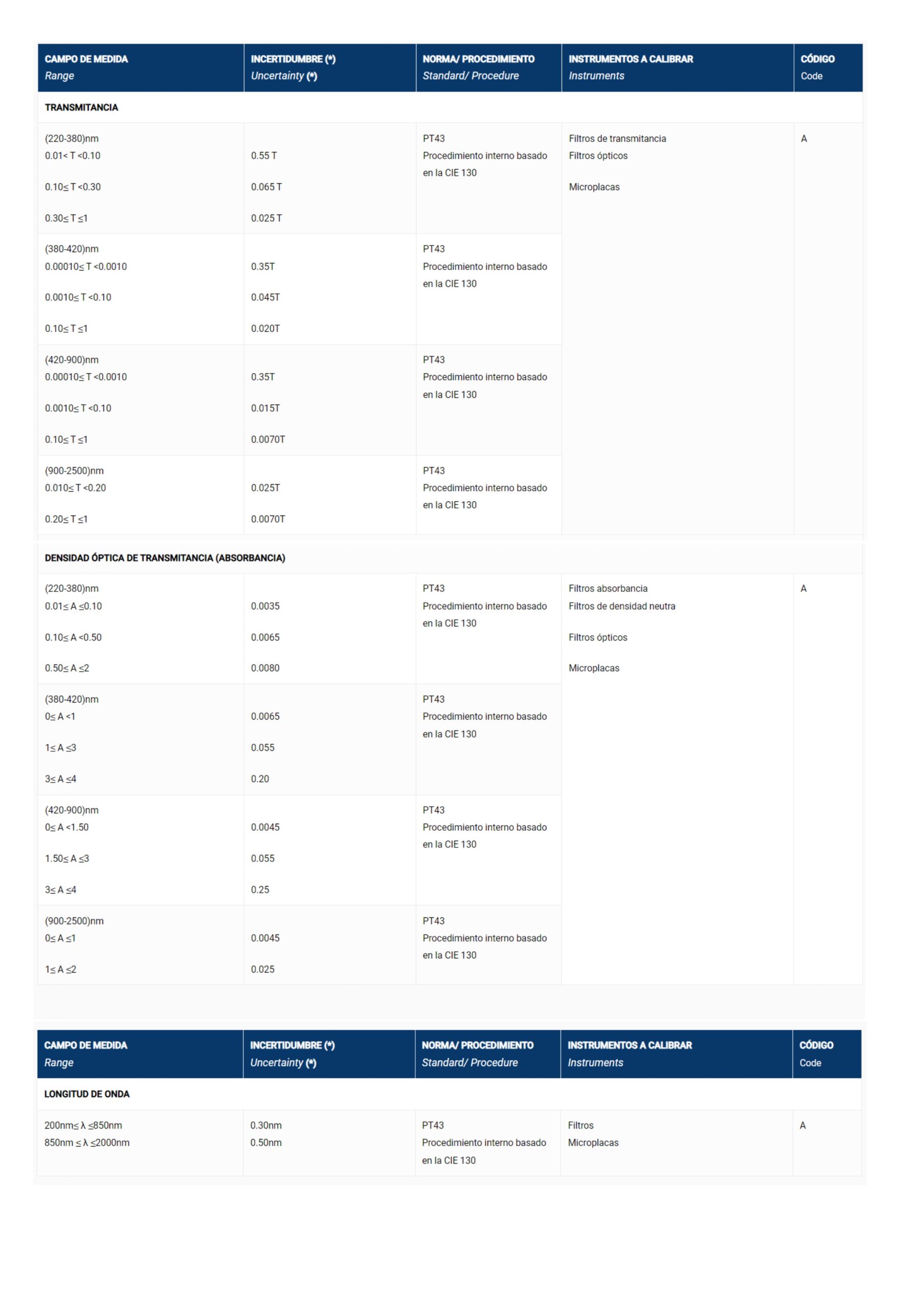
Laboratorios Eyco has ENAC accreditation for calibration of wavelength filters and neutral density filters.
The following shows the technical scope of Eyco Laboratories for the microplate calibration.
FAQ
What is an ELISA plate and what is it used for?
An ELISA plate It is a plastic microtiter plate (usually with 96 wells) designed for enzyme-linked immunosorbent assays. It is used in healthcare and research analyses to accurately detect and quantify antigens, antibodies, hormones, or proteins in biological samples.
What role do optical properties play in the reading of ELISA plates?
optical properties These measurements are fundamental, as the ELISA test result is determined by color changes (colorimetry) or fluorescence and luminescence signals. The transmittance and optical density of the plate material and the liquid sample must be measured with absolute precision to ensure an accurate diagnosis.
How does the microplate reader influence the reliability of the analysis?
El microplate reader or spectrophotometer This instrument is responsible for quantifying the intensity of the optical signal in each well. If this instrument exhibits photometric or wavelength deviations, the results of medical or food quality analyses can be seriously affected.
What critical elements should be controlled in the calibration of this equipment?
To ensure proper functioning in the optical measurement of ELISA plates, the following should be evaluated periodically critical parameters:
- The accuracy and repeatability of the absorbance scale (optical density).
- The accuracy of the wavelength selected in the spectrophotometer.
- The uniformity of the reading between the different channels and wells of the microplate.
- Optical alignment and stability of the reader's light source.
Why calibrate ELISA plate readers at Eyco?
Perform the calibration in a specialized laboratory such as Eyco It guarantees maximum precision and traceability in the measurement of optical properties. With experts in spectrophotometry, we ensure that our plate and microplate readers deliver valid, consistent, and technically rigorous results in accordance with the regulatory requirements of the healthcare and industrial sectors.