
The measure of retroreflection is used in highway traffic signs, high visibility clothing, license plates and reflective tapes.
The measurement of retroreflective properties in traffic signs, license plates or high visibility clothing is carried out in qualified laboratories through retroreflection tests.
Eyco Laboratories, in its effort to offer a wide range of services to client companies, expands its catalog and incorporates the retroreflection tests and retroreflectometer calibrationTo carry out these services, Eyco has a vertical retroreflectometer, for different lighting and observation angles.
Table of contents
What is retroreflection?
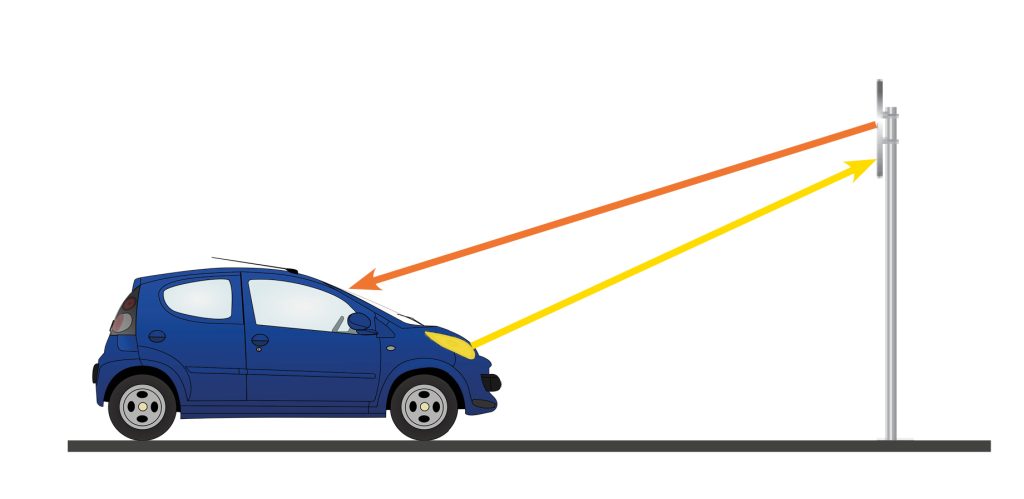
Retroreflection is the ability of some materials to reflect most of the light that falls on a surface, in the same direction as it but in the opposite direction.
The retroreflective materials They are mainly used in vertical or horizontal signage, in individual protection equipment, in license plates or reflective tapes. The purpose of their use in these elements is that they be seen in conditions of reduced visibility or in conditions of night visibility when the light coming from the headlights of the vehicles falls on them.
Now, to measure the retroreflection it is necessary to take into account:
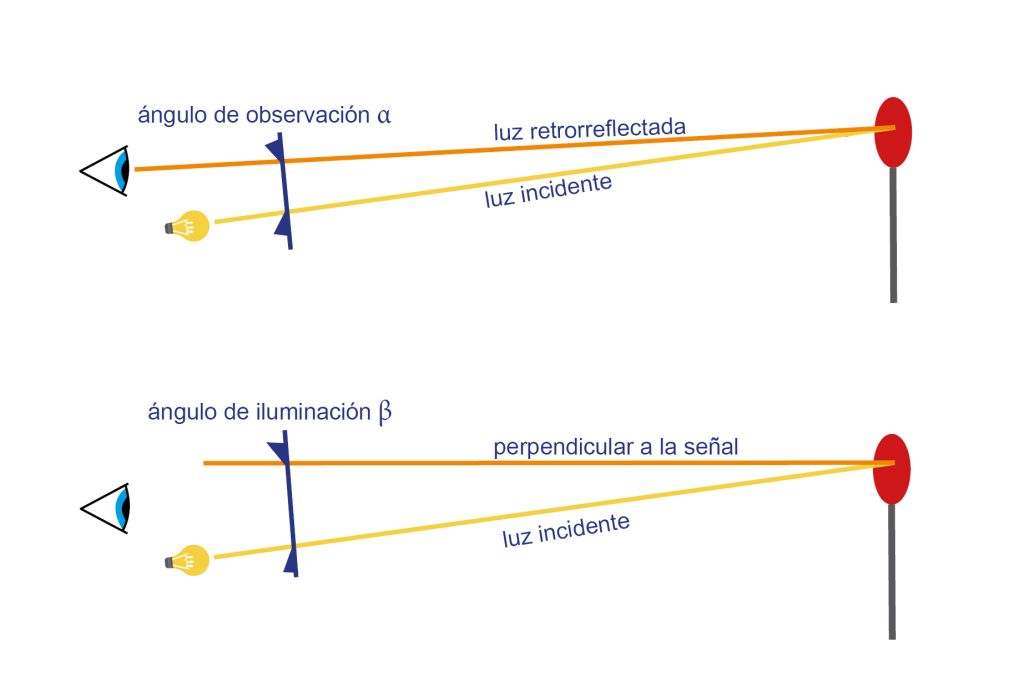
-The angle of observation (α), which measures the angular location of the eyes in relation to the center of the retroreflective beam.
-The angle of illumination (β), that is, the angle at which the incident light enters the retroreflective surface.
What is a retroreflectometer?
Un retroreflectometer It is an instrument with which things are done objective measurements of retroreflection on surfaces and materials.
Retroreflectometers can measure retroreflection of various colors and in various types of retroreflective materials.
To this end, these devices must be developed in accordance with the regulations concerning retroreflective materials in road traffic signs, high visibility clothinglicense plates and reflective tapes. Thus, these instruments must comply with the specifications in the following standards: UNE-EN 12899, UNE-EN ISO 20471, ASTM E 1709, ASTM E 2540, ASTM E 1809, UNE-EN 17353: 2020, UNE 135902: 2020, UNE-EN 13422: 2020 y UNE 135363: 1998.
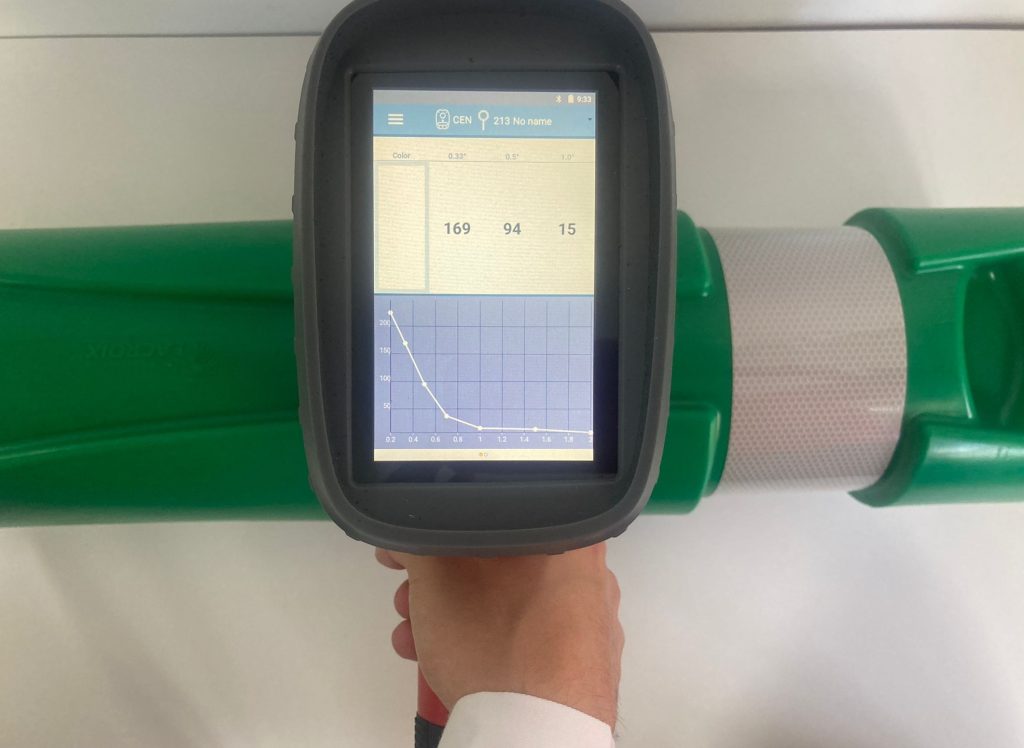
These kits measure the R-valueA (coefficient of retroreflected luminance at night). The RA is an important factor in on-site quality control of traffic signs. The unit used for RA is (cd lx-1 m-2 ). Now, the value of RA depends on the viewing angle (α). The viewing angle measures the angular location of the driver's eyes relative to the center of the retroreflective beam. When the observation angle (α) increases the value of RA decreases. For this reason, regulations have established a minimum value of RA according to the values of the angle of entry of the incident light in the traffic sign (β) and the angle of observation (α).
Retroreflection tests
Fixed vertical road signs
Regarding fixed vertical traffic signs, there are applicable regulations concerning retroreflective materialsSpecifically, the standard UNE-EN 12899 (part 1), the ASTM E 1709 and ASTM E 2540 address this topic.
First, part 1 of the UNE-EN 12899 standard «Fixed vertical road signs» specifies, among other things, the material characteristics of the retroreflective sign face. Thus, he points out that when the coefficient of retroreflection RA (cd lx-1 m-2 ) of a retroreflective material, with glass microsphere technology, is determined according to the procedure specified in the CIE 54.2 publication using standard illuminant A, the initial minimum coefficient of retroreflection must not be less than the values indicated in table 1 or 2 , as appropriate.
In addition, the standard states that the coefficient of retroreflection (RA) for all screen-printed colors, except white, must not be less than 70% of the values indicated in table 1 or table 2 for class RA1 and RA2 signals, respectively.
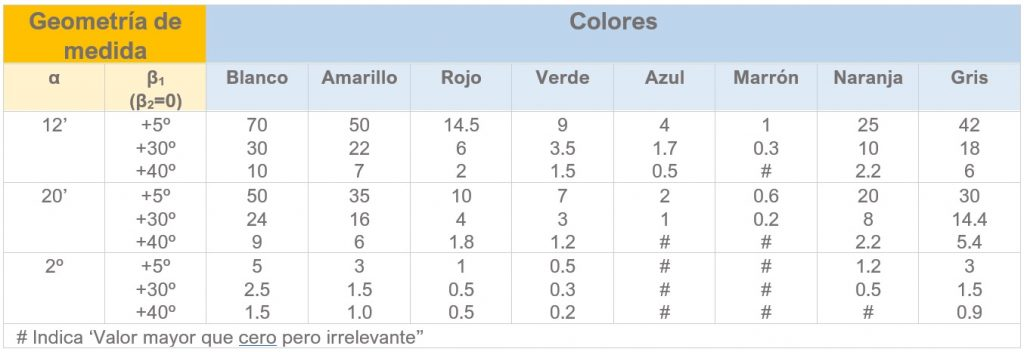
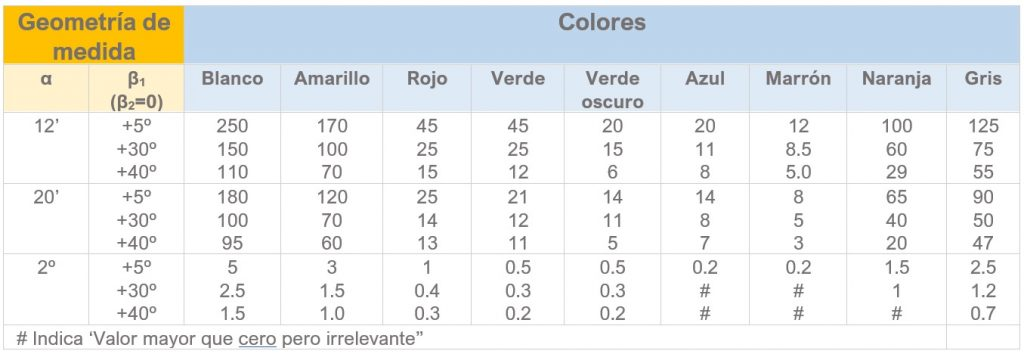
On the other hand, once the aging tests have been carried out, the standard indicates that the retroreflection coefficient must not be less than 80% of the values indicated in tables 1 and 2, when measured with an observation angle α of 20′. and incidence angles β1 = 5º and 30º, with β2 = 0º.
Another standard that refers to retroreflection is the ASTM E 1709, «Standard Test Method for Measurement of Retroreflective Signs Using a Portable Retroreflectometer at a 0.2 Degree Observation Angle». This standard covers the measurement of the retroreflective properties of sign materials, such as traffic signs and symbols (vertical surfaces), using a portable retroreflectometer.
The analogous method for an observation angle of 0.5 degrees is established in the standard ASTM E 2540 «Standard Test Method for Measurement of Retroreflective Signs Using a Portable Retroreflectometer at a 0.5 Degree Observation Angle».
In both cases, it is a method designed for field measurements. However, it can also be used to measure the retroreflective properties of materials before the sign is placed in place. Similarly, it can also be used to measure the properties of the material before it is applied to the sign.
Both ASTM E 1709 and ASTM E 2540 state that the retroreflectometer must be recalibrated frequently enough to ensure that large measurement uncertainties do not occur.
High visibility clothing
With regards to high visibility clothing, has the purpose of making the user visible with any type of light. To do this, it uses materials that must be effective both in relation to their photometric properties and due to the requirements of their minimum areas and layout or design.
Thus, in complex environments where objects compete visually, high-visibility clothing must be able to immediately attract visual attention, or in other words, be conspicuous. This ability is determined by its luminance and color contrast, its design, and its characteristic configuration and movement in relation to the background environment where it is to be seen.
In this way, retroreflection is one of the optical properties of materials addressed in regulations regarding high visibility clothing. Specifically, the rules UNE-EN ISO 20471, UNE-EN ISO 17353: 2020 y ASTM E 1809 specify requirements, test methods and minimum values for the coefficient of retroreflection in high visibility clothing.
In particular, the UNE-EN ISO 20471 standard «High visibility clothing. Test methods and requirements» defines three classes of clothing taking into account three different minimum areas of retroreflective, fluorescent and/or combined material. On the other hand, the standard specifies the retroreflection requirements both for the new material and for the material subjected to tests.
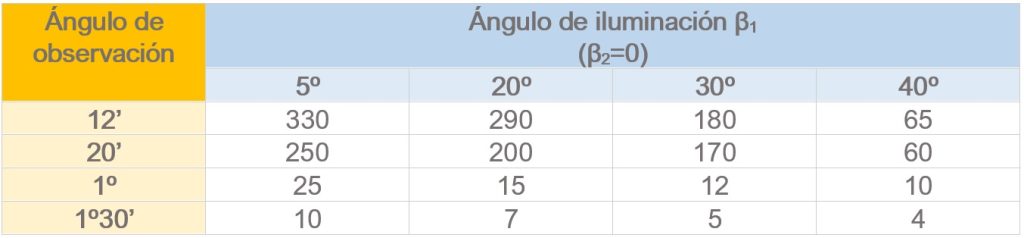
In the case of new materials, the standard indicates the following minimum values of the retroreflection coefficient in cd/(lx m2) for the single characteristic material:
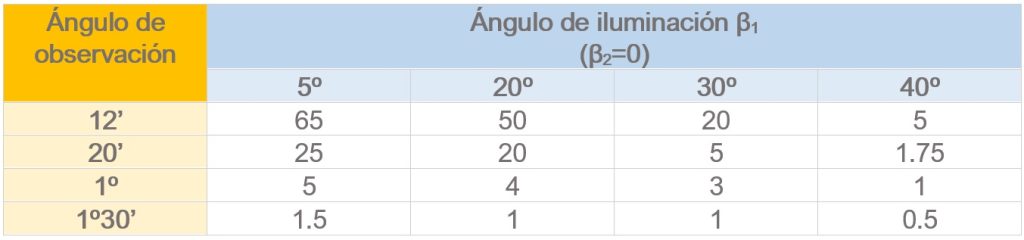
For its part, for the combined material, the standard specifies the following minimum values of the retroreflection coefficient in cd/(lx m2):
In addition, the material can be tested after being subjected to abrasion, flexing, low temperature folding, temperature variations, influence of rain, washing and dry cleaning tests.
The UNE-EN ISO 17353:2020 standard specifies the retroreflective performance requirements for new protective clothing materials, specifically for enhanced visibility equipment for medium-risk situations. Furthermore, the standard establishes the method for taking measurements. The protective clothing covered by this standard is designed to provide visibility to the wearer in medium-risk situations under any daylight conditions and/or low illumination from vehicle headlights or reflectors in the dark.
Finally, ASTM E 1809 "Standard Test Method for Measurement of High-Visibility Retroreflective-Clothing Marking Material Using a Portable Retroreflectometer", talks about measuring the retroreflective properties of high-visibility pedestrian clothing, such as vests, using a portable retroreflectometer.
Road signs
In addition to the above regulations, there are regulations applicable to other types of Road signage for retroreflection testing.
Specifically, part 3 of the standard UNE-EN 12899 deals with new retroreflective delineators and devices for use in areas with traffic flow.
Thus, this part of the standard establishes, among other things:
-The luminance factor and the chromatic coordinates of the eyeliners in daytime conditions.
-The luminance factor and the chromatic coordinates of retroreflective devices in daytime conditions.
-The chromatic coordinates of retroreflective devices in night conditions.
-The coefficient of retroreflection RA of retroreflective devices.
On the other hand, the standard UNE-IN 13422:2020 deals with portable deformable warning devices and delineators. That is to say, it attends to portable traffic signaling for highways, as is the case with cones and cylinders.
Also, the standard UNE 135902: 2020 establishes characteristics and test methods for urban road equipment, specifically, for retroreflective lane separator devices.
Finally, the UNE 135363: 1998 indicates the characteristics, measurements and test methods for beacons, in particular, for permanent cylindrical beacons in polymeric material.
Calibration and retroreflection testing at Eyco
Eyco has incorporated the retroreflectometer calibration and retroreflection tests to its catalog of services.
The following table shows the range of measurement and uncertainty in retroreflectometer calibrations.
RANGERange |
UNCERTAINTY (*)-- |
STANDARD/ PROCEDURE-- |
INSTRUMENTS TO CALIBRATEInstruments |
CODECode |
| Retroreflection (RA) | ||||
| 80 (cd lx-1· m-2)≤RA≤600(cd lx-1· m-2)
α=0,33º; β=5º |
± 3% | EN 12899
UNE EN ISO 20471 |
Vertical retroreflectometers | A,I |
Regarding retroreflection tests, Eyco has the technical capacity to perform customized retroreflection tests or tests adjusted to the following standards: UNE-EN 12899, UNE-EN ISO 2047, ASTM E 1709, ASTM E 2540, ASTM E 1809, UNE-EN 17353: 2020, UNE 135902: 2020, UNE-EN 13422: 2020, UNE 135363: 1998.
Eyco has extensive experience and high technical specialization in the area of optical equipment calibration and testing of the optical properties of materials. In fact, year after year, Eyco revalidates its leadership as the laboratory with the most extensive accreditation in Spain in the optical area.
FAQ
What is retroreflection and why is it important for road safety?
La retroreflection It is the optical property that allows a surface to reflect light directly back to its source, such as a vehicle's headlights reflecting light back to the driver's eyes. It is a key technical solution for ensuring nighttime visibility and quality control in essential road signage, drastically reducing the risk of accidents.
What specific services does Eyco offer in this area?
Eyco expands its catalog with the addition of retroreflection tests in various materials and the retroreflectometer calibrationThese services ensure accurate measurements of the luminance coefficient under national and international reference standards, consolidating their leadership in the optical properties sector.
What types of products and materials do these tests apply to?
The new tests and calibrations are designed to verify and control the optical performance of critical elements such as:
- Traffic signals vertical signs and road signs.
- High visibility clothing for workers and emergency teams.
- Vehicle registrations and reflective signaling devices.
- Materials used in road markings and signage.
Under what regulations are R-value measurements performed?A?
Precise measurements of the retroreflective intensity coefficient (R value)A) are strictly executed under the main reference technical standards, among which are the UNE-EN 12899 (for fixed vertical traffic signs), the UNE-EN ISO 20471 (for high-visibility protective clothing) and international regulations ASTM:.
What advantages does Eyco's cutting-edge technology offer?
Thanks to state-of-the-art equipment and solid technical expertise, Eyco offers exceptional analytical reliability. This allows manufacturers and government agencies to rely on the support of a laboratory specializing in the optical properties of materialsensuring regulatory compliance and the highest quality standards in the market.