Discover optical quality with Eyco and Hawkers Laboratories!
In the dynamic, ever-evolving world of fashion and sun protection, sunglasses have become an essential accessory that combines style and functionality. Furthermore, it is essential to keep in mind that sunglasses are not only fashion accessories, but also products designed to guarantee our safety against the sun's rays.
For this reason, sunglasses must meet the highest quality standards and undergo rigorous testing to evaluate their performance in accordance with established regulations.
In this article, we will exemplify, with the case of Hawkers, some of the tests that a sunglasses brand must undergo. In addition, we will present several results derived from the tests to which the sunglasses of this well-known brand have been subjected. On the other hand, we will address the relevant regulations for this type of products, specifically the EN ISO 12312-1 standard and regulations 21 CFR 801.410. Also, we will highlight the importance of carrying out tests that ensure the quality of sunglasses.
- Trend and trajectory: Hawkers' success throughout its history
- Hawkers excellence under the Eyco magnifying glass
- Rigorous Regulations: beyond fashion, towards safety
- Eyco Laboratories: rigor and experience in the optical area
Trend and trajectory: Hawkers' success throughout its history
Of Spanish origin and born in the digital environment in 2013, Hawkers has championed a paradigm shift in the sector since its creation under a groundbreaking online marketing model and a complete value proposition for consumers.
The company currently operates in more than 80 countries through its website, has more than 70 stores in Spain, Italy and Portugal, and has incorporated the optical division into its offering. Hawkers Eyewear, an expanding project, which already has 16 opticians between Spain and Portugal.
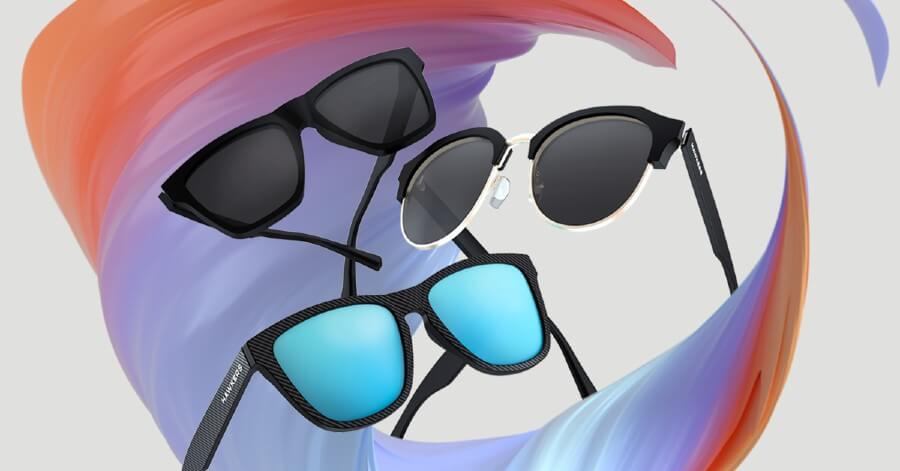
Hawkers is considered one of the top 10 most internationally recognized Spanish fashion brands. Just three years after its inception, the company ranked among the top 3 sunglasses brands worldwide in terms of units sold and is a global success story for Facebook, Twitter, and Shopify.
Hawkers excellence under the Eyco magnifying glass
But, beyond his successful commercial career, Hawkers is committed to the quality of its products. That is why the brand subjects its sunglasses to a series of tests in accordance with regulations. ISO 12312-1 y 21CFR 801.410.
In charge of these tests is Laboratorios EycoEyco specializes in optical testing and has extensive experience in the field of ophthalmic optics. Furthermore, Eyco is a laboratory recognized for its technical expertise, impartiality, and regulatory compliance.
The examples presented in this publication show the results of several tests conducted by Eyco Laboratories on Hawkers sunglasses. These results reflect strict compliance with international standards, such as EN ISO 12312-1 and 21 CFR 801.410. Regulatory compliance is essential to providing assurance to customers seeking safe and reliable products from a brand.
Rigorous Regulations: beyond fashion, towards safety
Sunglasses are more than a stylish accessory, they are personal protective equipment (PPE) that must comply with rigorous regulations to guarantee the health and safety of users. In this context, the Directive 89/686 / EEC establishes the essential health and safety requirements for PPE, including sunglasses.
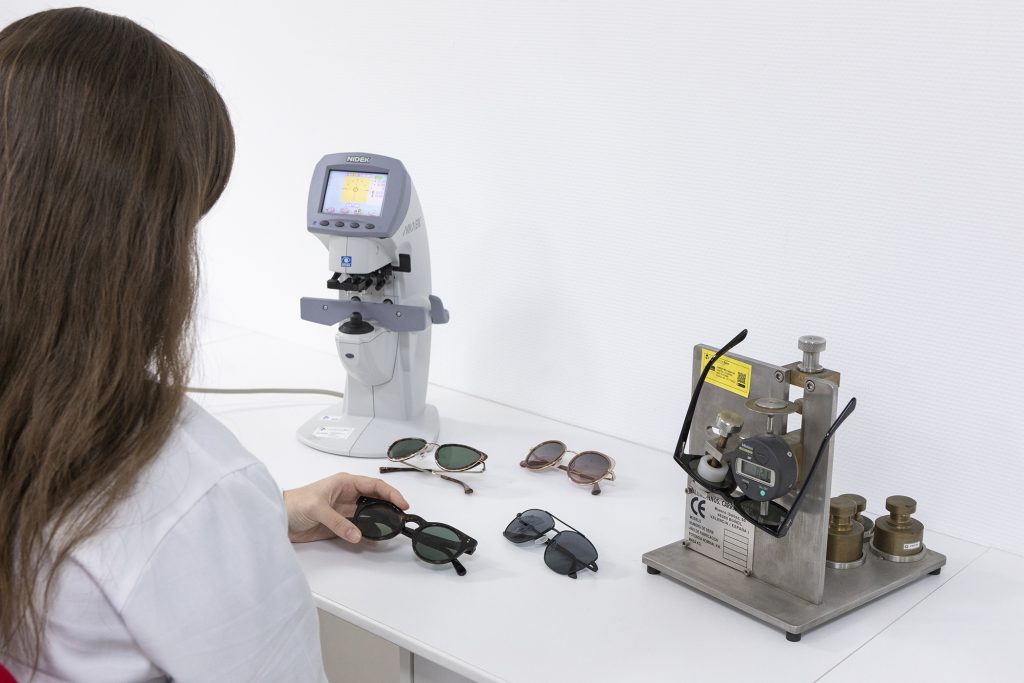
Protect your eyes in style: find out all about the EN ISO 12312-1 standard for sunglasses
The ISO 12312-1 specifies requirements and test methods to ensure the safety and quality of sunglasses for general use. Below we present a summary of the key points and classification of the essays.
Key points of the EN ISO 12312-1 standard
1. Optical requirements:
•Spectral transmittance.
•Luminous transmittance and filter category.
•Homogeneity of transmission.
•Spherical and astigmatic power.
2. Mechanical requirements:
•Construction and materials.
•Mechanical strength.
•Retention and deformation of the bridge.
3. Other requirements:
•Ignition resistance.
•Resistance to solar radiation.
Mandatory tests
Optical tests:
- Spectral Transmittance: Measures the amount of light that passes through lenses at different wavelengths.
- Luminous transmittance: evaluates how much visible light reaches the eyes through the glasses.
- Homogeneity of light transmission: verifies the uniformity of light transmission across the entire surface of the lenses.
- Optical Distortion: Examines any warping or distortion in the vision through the glasses.
Mechanical tests:
- Minimum filter robustness: specifies the minimum standards that filters must meet in terms of resistance and durability.
- Bridge Retention and Deformation: Requirements are detailed to ensure that the filter frames do not deform easily and that they effectively hold the filters in place.
- Construction: describes the standards and requirements for the manufacturing and general structure of the glasses or protective equipment that contain the filters.
- Filter Material and Surface Quality – Sets specifications for the filter material itself and its surface quality.
- Physiological Compatibility: Addresses ensuring that filters do not cause physiological harm or discomfort to the user.
Other tests:
- Resistance to solar radiation: details how filters must protect against solar radiation and meet certain resistance standards.
- Ignition resistance: establishes requirements to ensure that filters are not easily flammable or susceptible to ignition.
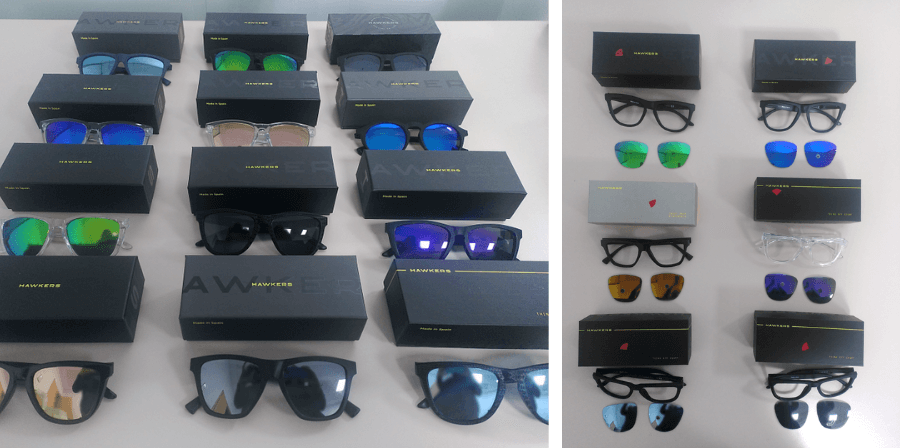
Optional essays
These tests may be necessary depending on the specific characteristics of the product or the manufacturer's requirements, although they are not mandatory according to the standard.
Thus, for example, the following mechanical tests are optional:
- Filter impact resistance, resistance level 1.
- Greater resistance of sunglasses.
- Filter impact resistance, resistance level 2 or 3.
Going deeper into some of the tests required by ISO 12312-1. Practical examples of Hawkers sunglasses
Luminous transmittance. Sunscreen category
Choosing the right sunglasses goes beyond style; It is crucial to consider its ability to protect our eyes from harmful ultraviolet (UV) rays. According to the standard ISO 12312-1, these glasses are classified into five categories based on the luminous transmittance of their solar filters, from level 0 to 4. The highest categories, such as 4, offer an absorption of more than 90% of light rays and are Designed for extremely sunny environments, such as mountains or snow. On the other hand, lower categories, such as 0 or 1, are ideal for less sunny conditions, such as cloudy or indoor days, but may not be safe for night or day driving depending on their level of darkness.
Darker lenses do not guarantee greater UV protection, and lighter glasses do not automatically mean safer driving. Therefore, it is essential to select sunglasses according to their filter category, considering the purpose of their use.
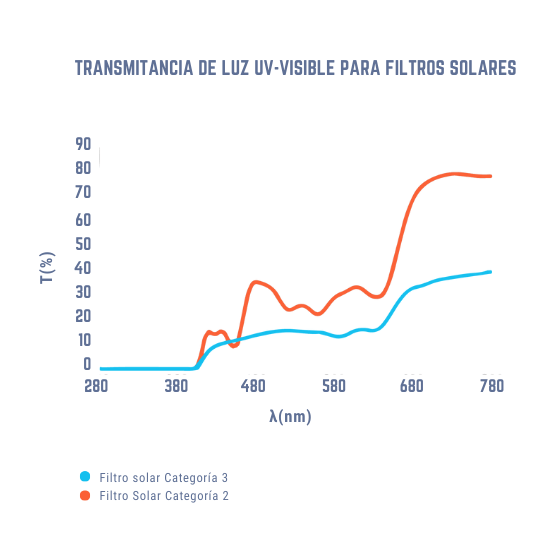
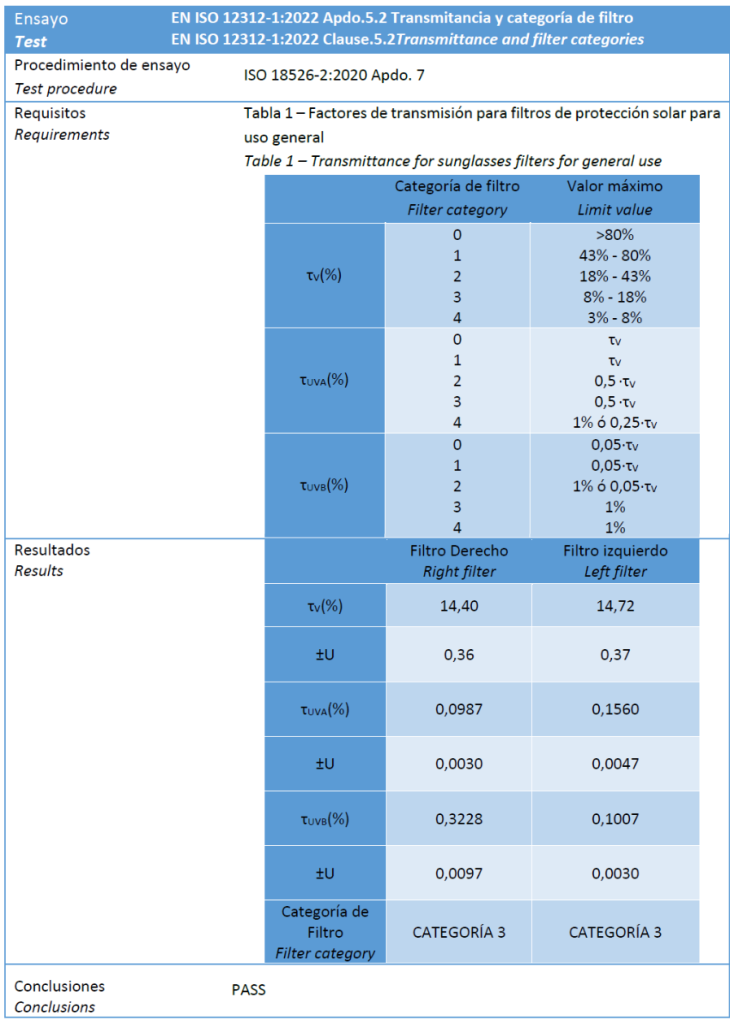
The table below shows the results of a test carried out on sunglasses of HawkersSpecifically, in relation to section 5.2 of the EN ISO 12312-1 standard. This section addresses spectral transmittance and filter category.
Diffused light
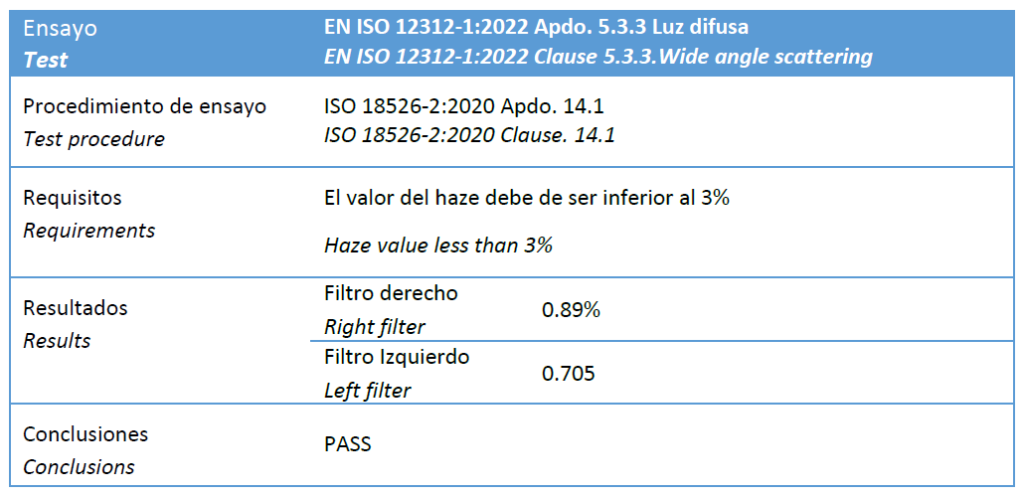
On the other hand, the ISO 12312-1 Section 5.3.3, concerning diffuse light, establishes the specific parameters and requirements for classifying solar filters with respect to diffuse light transmission. This section details the standards that filters must meet to guarantee adequate protection against indirect and diffuse solar radiation, thus ensuring optimal eye safety for the user against this type of ambient light. These specifications are fundamental to guaranteeing the effectiveness and quality of solar filters in accordance with the guidelines established by EN ISO 12312-1.
The following table shows the results of a test related to section 5.3.3, on sunglasses. Hawkers.
Diffused light. According to EN ISO 12312-1:2022
Minimum mechanical resistance
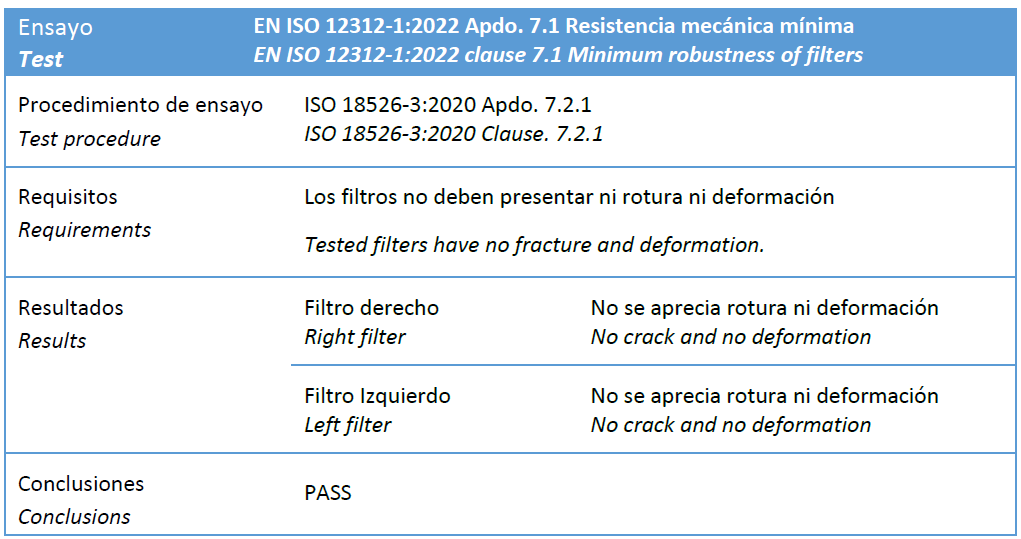
Regarding section 7.1. of the rule ISO 12312-1 establishes the fundamental requirements for the minimum mechanical resistance of products designed for eye protection against solar radiation. Thus, this section details the tests and standards that must be met to ensure that sunglasses lenses and frames are durable enough for regular use. These tests include evaluating the durability of materials, resistance to impacts and deformations, ensuring that products meet rigorous quality and safety standards to provide effective protection to those who use them.
The results of a test referring to this section of the standard, carried out on sunglasses, are exemplified below. Hawkers.
Minimum mechanical resistance. According to EN ISO 12312-1:2022
Bridge retention and deformation
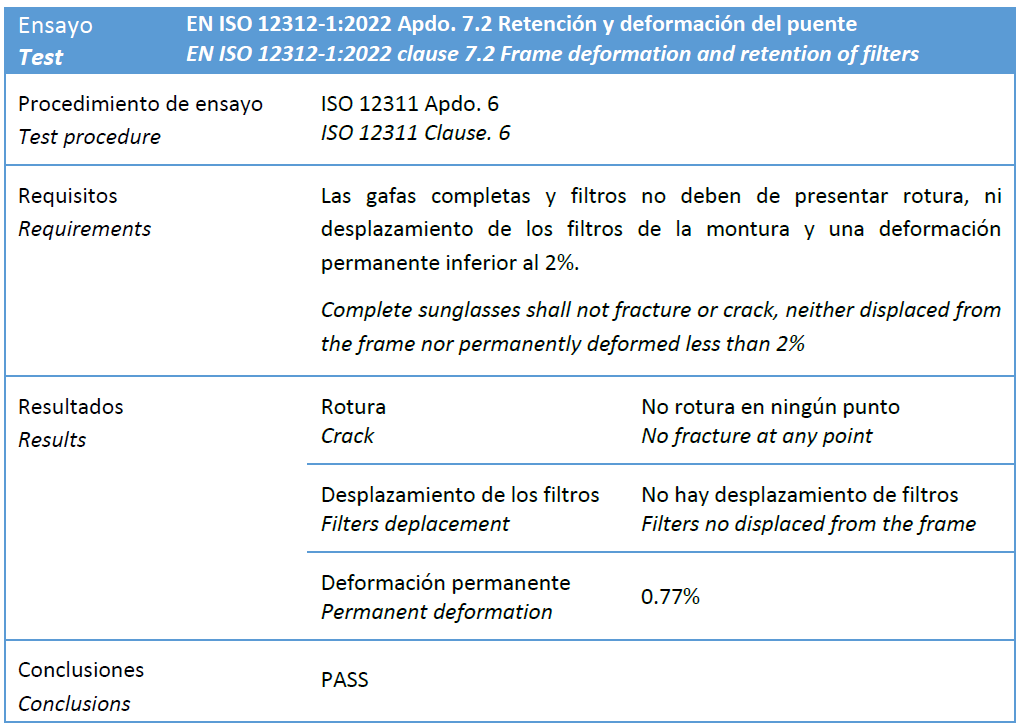
For its part, section 7.2 of the standard ISO 12312-1, regarding bridge retention and deformation, details the crucial requirements to ensure that sunglasses maintain their optimal structure and shape. These specifications focus on the strength of the glasses bridge, ensuring that it can withstand stresses and maintain its integrity during regular use. Additionally, it addresses allowable deformation within acceptable limits, preventing the shape of the bridge from distorting in a way that affects the comfort or effectiveness of the glasses. This section highlights the importance of the durability and functionality of the bridge component in sunglasses, which ensures the quality and reliability of the final product.
The data presented in the following table is an example of the results obtained from tests carried out on the brand's sunglasses. Hawkers.
Retention and deformation of the bridge. According to EN ISO 12312-1:2022
Explore the 21 CFR 801.410 Standard on Impact Resistant Lenses in Sunglasses
The 21CFR 801.410, establishes labeling requirements for eye protection devices, including sunglasses. These requirements have been established by the United States Food and Drug Administration (FDA). Their role is to ensure that consumers receive accurate and complete information about the features and performance of the sunglasses they are purchasing.
La FDA has the responsibility of ensuring the safety and effectiveness of a wide variety of products, including sunglasses.
This US administration regulation, in section 801.410, addresses impact resistance in sunglasses. This section includes standards for impact resistance, the test methods to be used to evaluate that resistance, and the labeling requirements to inform consumers about the impact resistance of products. Therefore, when exporting sunglasses to the US, the FDA requires that they undergo the impact test defined in 21 CFR 801.410.
Below is an example of one of the impact resistance tests to which the sunglasses have been subjected. Hawkers, according to standard 21 CFR 801.410:
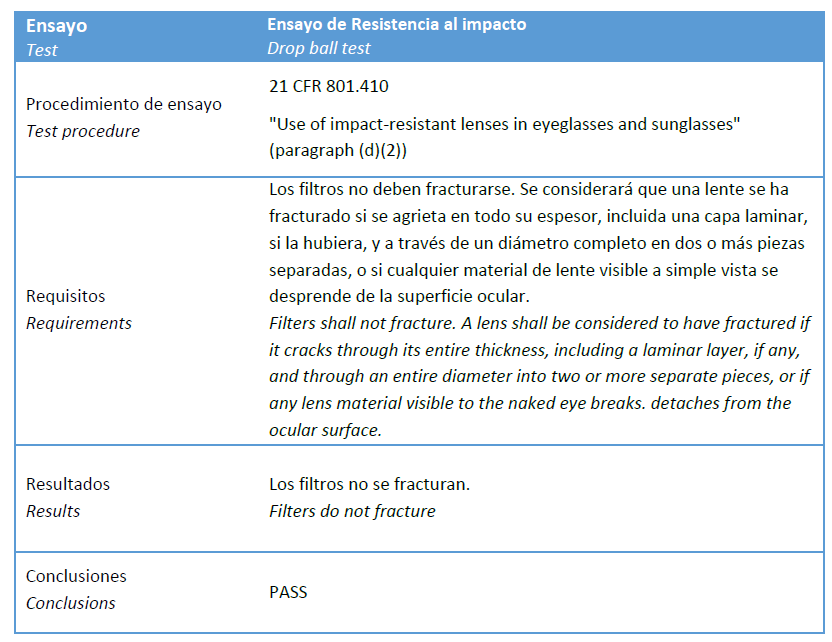
According to standard 21 CFR 801.410.
Test results according to this standard confirm that Hawkers sunglasses meet the required standards. Therefore, the lenses did not fracture when subjected to the impact test.
Eyco Laboratories: rigor and experience in the optical area
Laboratorios Eyco stands out as a reference in the field of optical testing and, after extensive experience, has established itself as a recognized expert in the field of ophthalmic optics.
With a solid track record and an undeniable commitment to quality, Eyco is accredited by the National Accreditation Entity (ENAC) to carry out tests on sunglasses in accordance with the regulations ISO 12312-1This accreditation guarantees that Eyco Laboratories meets the most rigorous international standards, ensuring the reliability and accuracy of its assessments.
Furthermore, Eyco's technical capabilities extend even further, as it has the experience and expertise to conduct tests in accordance with other regulations, such as the standard 21CFR 801.410, which reinforces its position as a reliable partner in quality assurance in ophthalmic products.
FAQ
What regulations guarantee the optical and mechanical quality of Hawkers sunglasses?
Hawkers sunglasses undergo rigorous technical testing under international standards ISO 12312-1 for the European market and the strict regulation of the FDA 21 CFR 801.410 for the US market, ensuring its full compliance with global safety standards.
What do the optical tests performed by Eyco consist of?
The optical tests They evaluate critical properties such as light transmittance, traffic sign recognition, spherical, astigmatic, and prismatic power, as well as lens homogeneity. This ensures that the glasses effectively protect your vision without causing distortion or eye strain.
How is the impact resistance and safety of lenses evaluated?
Tests are applied mechanical strength, such as the ball impact test under FDA regulation 21 CFR 801.410. This procedure verifies that the lenses of the sunglasses do not break or chip upon physical impact, protecting the integrity of the user's eyes.
What kind of laboratory tests are applied to eyeglass materials?
To ensure the durability and protection of sunglasses against daily use and environmental exposure, the following laboratory analyses are performed:
- Transmittance spectrum measurement to certify the exact percentage of UV protection.
- Resistance tests to solar radiation to prevent premature degradation of the materials.
- Resistance tests to ignitionensuring that the frame and lenses are safe from heat sources.
Why is Hawkers' collaboration with a specialized laboratory like Eyco so important?
Have the support of EycoExperts in the measurement of optical properties allow Hawkers to scientifically guarantee that its products not only follow the latest fashion trends, but also strictly comply with the technical requirements for visual protection and resistance demanded by international organizations.