There are many products that use photoluminescent pigments for various purposes. Thus, the setting of natural spaces, interior and exterior decoration, fashion, safety at work or even care for the environment make use of this type of pigments.
The quality and quantity of the photoluminescent pigment used to make these types of products affects their performance. For this reason, the manufacturers of these products usually choose to carry out tests in which the is measured luminance and attenuation time.
Therefore, the demand for trials in this field goes beyond the fire safety industryThese analyses are necessary to comply with regulations. As a result, more and more sectors are becoming interested in this type of laboratory analysis to verify the quality of their products.
Next, we show some examples of innovative products using photoluminescent materials.
Paredes footwear (photoluminescent sole)
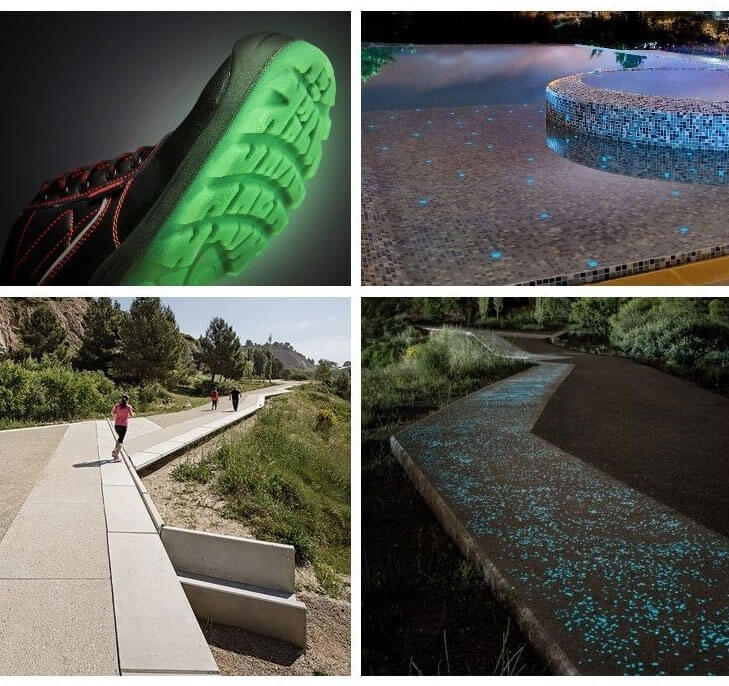
The TOP line of the well-known footwear brand Paredes has brought to the market two models of safety footwear with sole photoluminescent: the Alumio shoe and the Fósforo boot.
This solution is very useful in environments with poor visibility. The sole is charged after exposure to a light source, both solar and artificial. Thus, it emits light immediately in dark environments. So these soles become easily detectable light sources in the dark.
Photoluminescent sole of the Fósforo and Aluminio models of Paredes Seguridad
Paredes Seguridad has designed this product with airport personnel, fishing industry workers or machinery operators in mind. But also in mechanics, construction personnel, security guards or mining and steel workers. Other target users are delivery staff and messengers, maintenance workers, public works personnel, plumbers or refrigeration technicians, among others.
Safety Fósforo Boot by Paredes, under exposure to a light source (left) and in dark condition (right)
NightWay® (photoluminescent building products)
A range of unique products are those of the brand NightWay®. This company, in addition to producing ultra-photoluminescent paving stones and tiles, also manufactures concrete. photoluminescentIn addition, the company develops decorative resin or grout and other products for construction.
Photoluminescent concrete pavement supplied by NigthWay® for the peri-urban environmental project carried out in the Camí de les Guixeres (Anella Verda) by the City Council of Igualada.
NightWay® products seek to contribute to urban sustainability by reducing light pollution, improving energy efficiency and reducing the CO2footprint. In addition, NightWay® proposes to create aesthetic projects in unique buildings, private homes and private green areas. All this through the use of photoluminescence. The firm also wants to offer local administrations the possibility of carrying out projects that generate new opportunities for activity in public spaces.
Eco-Bollards NightWay®
Paths in the Natural Park of L'Albufera (Valencia) with NightWay® CONVEX tiles
Reviglass Mosaic and its Luminis collection
Another sector that has known how to take advantage of the potential of Solutions photoluminescent It is the ceramics industry. Both indoors and outdoors, ceramic tiles offer a host of decorative possibilities.
Pool covered with tile from the Luminis collection by Reviglass Mosaic
An example of this is the Luminis collection from the glass mosaic firm Reviglass. This tile provides a photoluminescent effect that lasts several hours after exposing the material to a light source. Given that sunlight is the most effective on this product, especially if it has a direct incidence, it is not surprising that the mosaic tiles in this collection are used very often in swimming pools.
Despite this, the additional use of artificial lighting sources tends to increase and enhance the photoluminescent effect of the tiles when the light source is turned off.
Tile from the Luminis collection by Reviglass Mosaic
In particular, the luminance It refers to the amount of light that passes through or is reflected by a specific area in a given direction, and the fade time This is the time it takes for the product to gradually stop emitting light until it is completely extinguished when it is no longer exposed to a light source.
Laboratorios Eyco, experts in optical testing
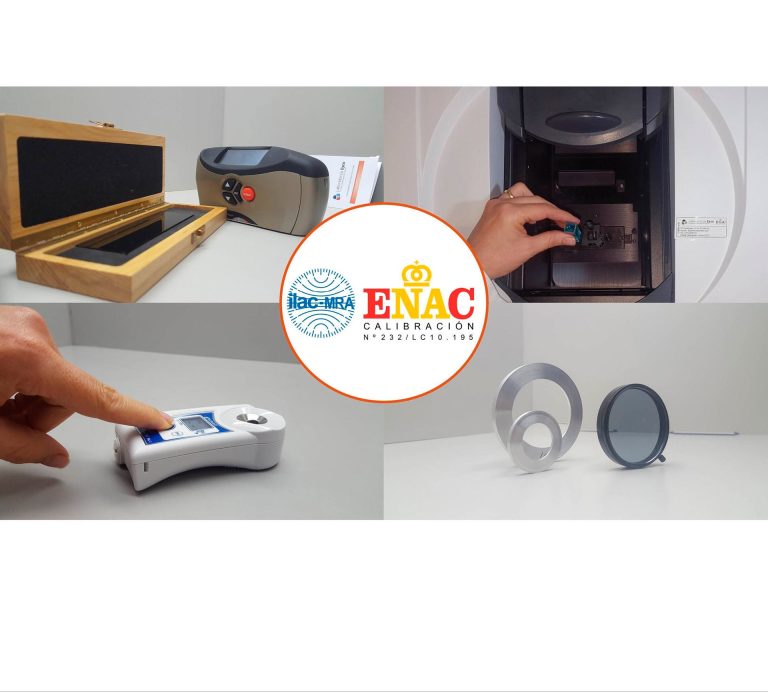
Laboratorios Eyco is the only laboratory accredited by ENAC in Spain and Portugal to carry out luminescence laboratory tests.
Furthermore, Eyco is the laboratory with the highest degree of specialization in the optical field in Spain, since it has the most extensive ENAC accreditation scope in the country in this area.
FAQ
What are photoluminescent products and how do they work?
The photoluminescent products They are materials capable of absorbing energy from electromagnetic radiation (such as natural or artificial light) and storing it, to later emit it in the form of visible light for a prolonged period, even in conditions of total darkness.
In which sectors are these innovative ideas being applied?
Innovation with photoluminescent materials is expanding rapidly in sectors such as safety and sports footwear, the sustainable construction (integrated signage) and exterior design using cladding such as Photoluminescent mosaic tiles for swimming pools and urban areas.
Why is it necessary to analyze photoluminescent products in a laboratory?
Laboratory analysis is essential to verify the quality, efficiency and luminance attenuation over time. This ensures that the products meet the brightness and durability levels required by safety regulations before being released to the market.
What regulations govern luminance testing for these products?
Depending on the application of the photoluminescent product, different [methods/methods] are applied. reference standards in the testing laboratories:
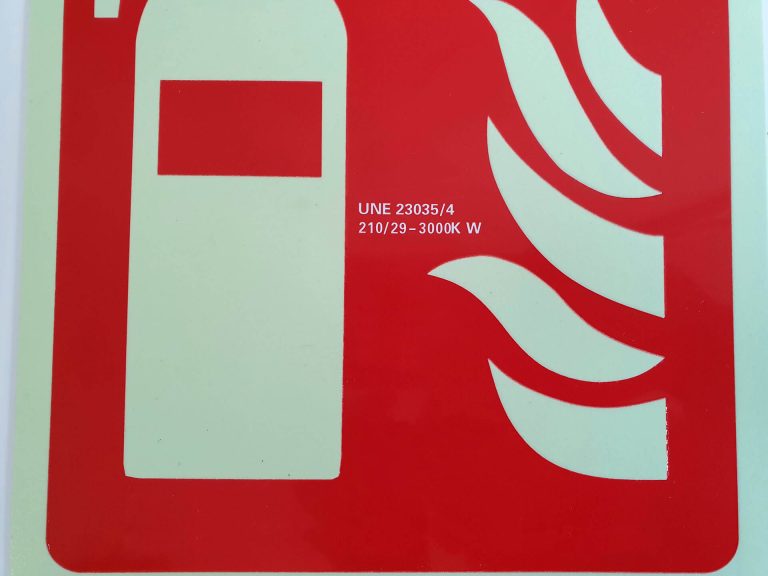
The UNE 23035, which regulates photoluminescent safety signaling systems.
International standard ISO 16069, focused on guidance systems for evacuation routes.
Specific regulations depending on the sector, such as the evaluation of optical properties in textiles or technical plastics.
What advantages does Eyco offer in the testing of photoluminescent materials?
As a laboratory specializing in the measurement of optical properties, Eyco It has the precise scientific instrumentation to evaluate the luminance decay curve. Conducting these tests with experts ensures reliable results, optimal for internal quality control and compliance with commercial technical requirements.
To offer the best experiences, we use technologies such as cookies to store and / or access device information. The consent of these technologies will allow us to process data such as surfing behavior or unique identifications on this site. Not consenting or withdrawing consent may adversely affect certain features and functions.
Functional
Always active
The storage or technical access is strictly necessary for the legitimate purpose of allowing the use of a specific service explicitly requested by the subscriber or user, or for the sole purpose of carrying out the transmission of a communication through an electronic communications network. .
Preferences
Storage or technical access is necessary for the legitimate purpose of storing preferences not requested by the subscriber or user.
Global Data
The storage or technical access that is used exclusively for statistical purposes.Storage or technical access that is used exclusively for anonymous statistical purposes. Without a request, voluntary compliance by your Internet service provider, or additional logging by a third party, information stored or retrieved solely for this purpose cannot be used to identify you.
Marketing
Storage or technical access is necessary to create user profiles to deliver advertising, or to track the user across one or multiple websites for similar marketing purposes.