Ensuring the quality of the coffee that reaches the consumer is a task that involves, among other things, verifying that the grain roasting be on point.
Color is the parameter most used by the coffee producing industry as an indicator of degree of roasting is the colorAlthough other indicators such as pH or chemical composition are also used. In addition, indicators such as mass loss, grain temperature, aroma, or flavor are widely used by this industry.
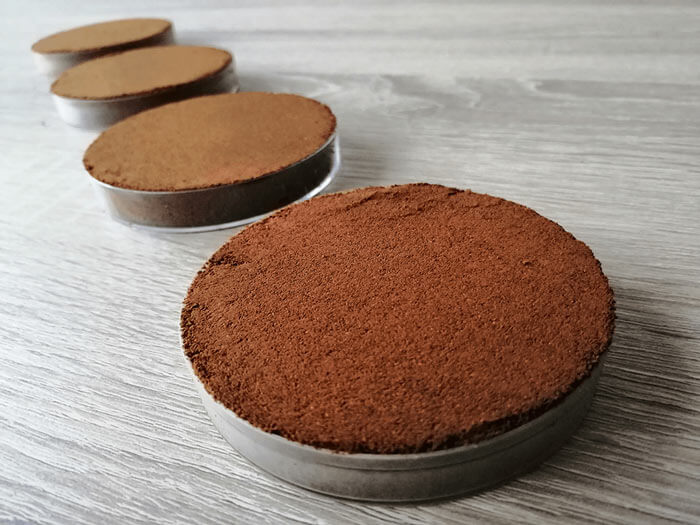
Samples of roasted coffee from the Cafento firm
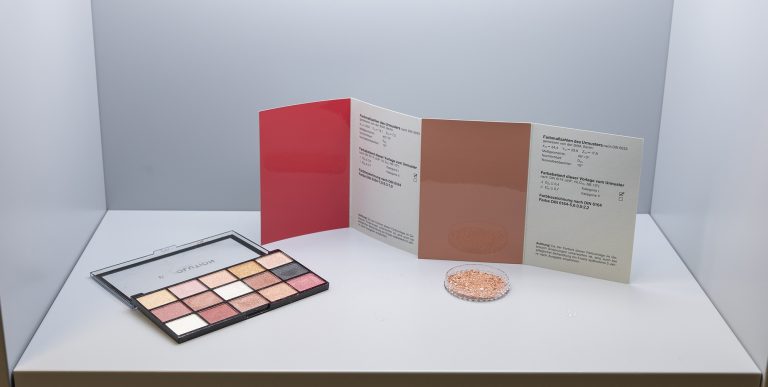
La color measurement In the coffee industry, this is usually done using equipment called colorimeters and their corresponding color standardsThe industry of eating She is not the only one who uses this type of measuring instrumentsIn this way, the packaging industry, the plastic and chemical industryTo name a few, they use this equipment in order to guarantee the quality of their production.
The measures offered by this type of instrumentation are objective. These measurements are fundamentally based on the same principle by which people perceive color. Values are displayed as difference from a standard. Another way to display them is relative to some scale with various roast levels (light, medium, medium dark, dark). They can also be displayed as a 'pass/fail' type value, or even referring to some industry standard, such as the one in the Specialty Coffee Association (SCAA).
Coffee samples with differentroast levels. Cafento.
The standards and equipment must be calibrated periodically so that the production company can guarantee that the measurements taken are reliable with respect to the standard.
Companies like the Asturian Cafento are aware of the importance of the calibration of your instrumentation y standards Cafento is committed to providing its customers with the highest quality. It has a production capacity of 21 million kilos per year and boasts an extensive distribution network throughout Spain, with growing international expansion.
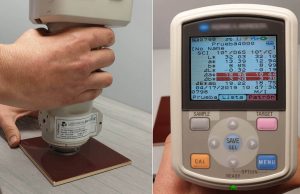
Measurement of color coordinates in a standard
CIE Lab*
La CIE (Commission Internationale de l'Eclairage) defined some color spaces, among which is the CIE Lab*. This is commonly used to evaluate and express the color of an object by manufacturers, laboratories, and researchers.
In this way, the color can be objectively expressed with numerical values. Specifically, L* indicates the luminosity and a* and b* are the chromaticity coordinates. Thus, a* expresses the red/green coordinates (with +a being red, and -a being green), and b* expressing the yellow/blue coordinates (with +b being yellow, and -b being blue).
The colorimeters, spectrophotometers and other color measuring instruments transform these color attributes into numerical values for each coordinate L*, a* and b*.
Eyco works with a wide variety of sectors. Among them is the industry of eating and related sectors such as packaging and the packaging industry plastic or the sector of water.
FAQ
Why is it important to measure the color of the coffee roast?
El coffee roast color It is the most critical visual and technical indicator for determining the degree of roasting of the bean. Its precise measurement guarantees the consistency of the flavor, aroma, and quality profile of the final product in each batch, avoiding subjective variations that could affect the consumer experience.
What instruments are used to objectively measure the degree of toasting?
The coffee industry uses high-precision optical equipment such as Colorimeters and SpectrophotometersThese instruments eliminate human error and eye strain, capturing accurate numerical data from coffee samples, whether whole bean or ground.
What color space is used in the technical analysis of coffee?
It is mainly used the CIE Lab color space*This system mathematically defines color using three coordinates: L* (luminosity, key to the level of light or dark), a* (axis from red to green tones) and b* (axis from yellow to blue tones), which allows for rigorous quality control in agri-food production.
What elements should be checked to ensure reliable color measurements?
To obtain reproducible and stable results over time, it is essential to control two fundamental pillars:
The measuring equipment (colorimeters and spectrophotometers), to correct optical and electronic deviations.
The calibration patterns of the instruments themselves, which act as the physical color reference and must be kept in perfect condition.
Why do these devices need to be calibrated periodically at Eyco?
Periodic calibration in EycoExperts in optical properties, guarantee the traceability, accuracy, and technical validity of their measurements. Properly calibrated equipment ensures that the data obtained at the production plant meets international quality standards, protecting brand value and optimizing industrial processes.
To offer the best experiences, we use technologies such as cookies to store and / or access device information. The consent of these technologies will allow us to process data such as surfing behavior or unique identifications on this site. Not consenting or withdrawing consent may adversely affect certain features and functions.
Functional
Always active
The storage or technical access is strictly necessary for the legitimate purpose of allowing the use of a specific service explicitly requested by the subscriber or user, or for the sole purpose of carrying out the transmission of a communication through an electronic communications network. .
Preferences
Storage or technical access is necessary for the legitimate purpose of storing preferences not requested by the subscriber or user.
Global Data
The storage or technical access that is used exclusively for statistical purposes.Storage or technical access that is used exclusively for anonymous statistical purposes. Without a request, voluntary compliance by your Internet service provider, or additional logging by a third party, information stored or retrieved solely for this purpose cannot be used to identify you.
Marketing
Storage or technical access is necessary to create user profiles to deliver advertising, or to track the user across one or multiple websites for similar marketing purposes.