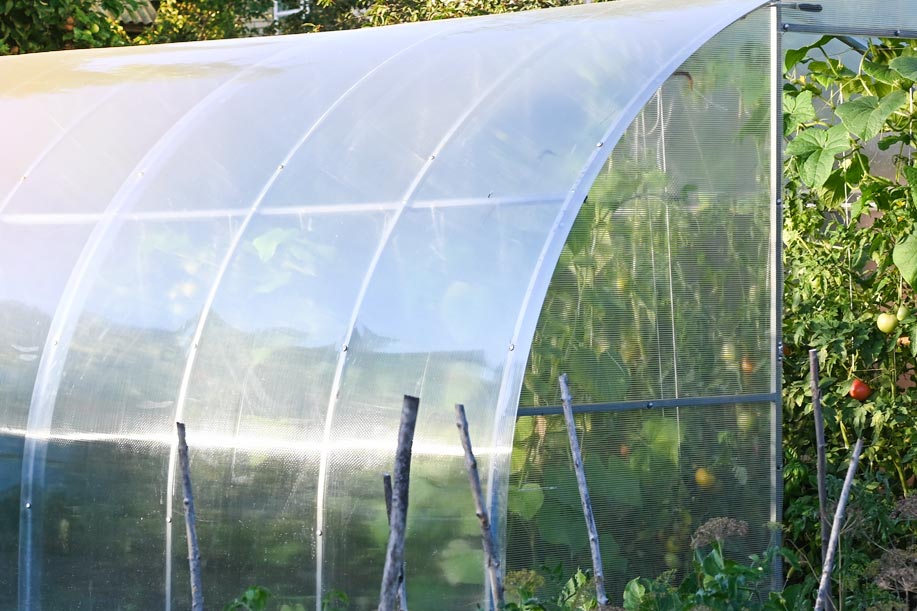
The UNE-EN 13206:2017 standard specifies the requirements related to the characteristics of thermoplastic films used to cover greenhouses.
Within its characteristics we find the mechanical, optical and thermal properties, in addition to the dimensional characteristics.
Specifically, in this article we are going to focus on the plastic films used for greenhouses and their optical characteristics:
How does a greenhouse work?
The greenhouses allow increase the temperature inside at the same time as the plants get enough sunlight to carry out photosynthesis.
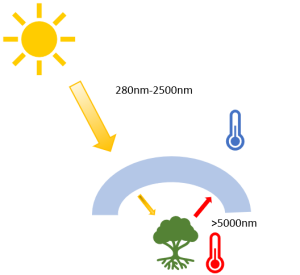
Solar radiation passes through the greenhouse cover (either glass or translucent plastic) reaching its interior.
Indoor objects (plants and crops) emit infrared radiation (of longer wavelength) that is trapped inside the greenhouse, as they cannot pass through the plastic or glass.
This phenomenon causes the interior to heat up compared to the exterior, generating a suitable climate for the growth of plants and crops.
Below we explain what optical properties should be considered and analyzed according to the Standard, we will indicate the classification of plastic films established by the Standard based on optical properties and we will name the requirements to be met.
We will use two plastics as an example, one of them unused and the other used and therefore already exposed to inclement weather and the environment. The thickness of both samples is approximately 180µm.
In both plastics their optical properties have been tested according to the Standard UNE EN 13206.
Optical characteristics for a greenhouse
The optical characteristics of a plastic film for use in greenhouses are:
Visible Light Transmission
A fundamental property of plastic greenhouse films is to transmit light in the range of photosynthetic activity.
The total transmission of visible light is determined according to the Standard ASTM D 1003-13, in the spectral range from 380nm to 780nm.
The spectral transmittance of a plastic film is the incident radiation that passes through said filter for each wavelength. From this spectral transmittance, the visible transmission factor (VT) is calculated considering an illuminant and the photopic vision curve.
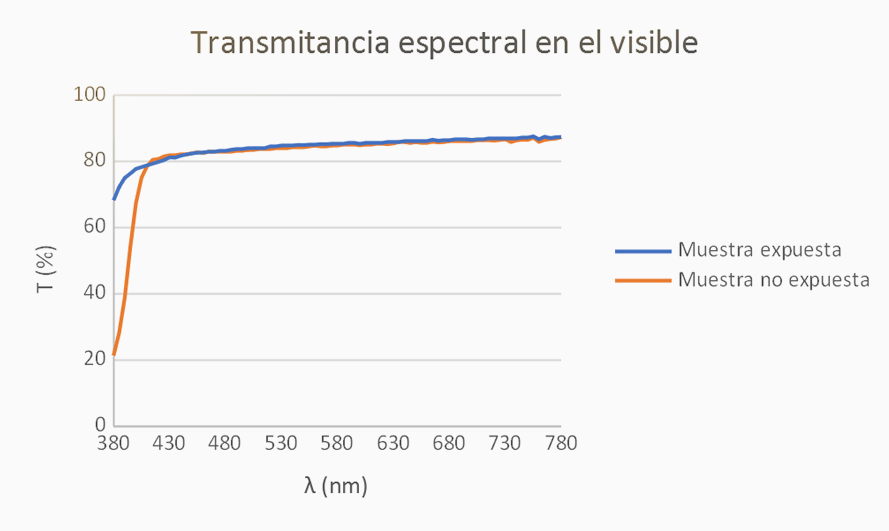
The following graphs show the transmittance curve of the two samples that we have tested. The measurement of this curve has been carried out with a measurement geometry of 0º:di, that is, diffuse transmittance.
As can be seen from 400 to 780nm the transmittance is practically the same in both samples. The difference is found below 400nm, where the exposed sample transmits a greater amount of light. However, this difference does not affect the calculation of the transmission factor in visible VT. Both samples have practically the same value.
Therefore it is important to know both values: spectral transmittance and transmission factor to understand the optical properties of plastics.
| VT(%) | |
| Exposed sample | 85,1 |
| Unexposed sample | 85,2 |
| Exposed sample TV(%):85,1 |
| Unexposed sample TV(%):85,2 |
Turbidity (Haze) and light diffusion
Turbidity should be determined in accordance with ASTM D 1003-13.
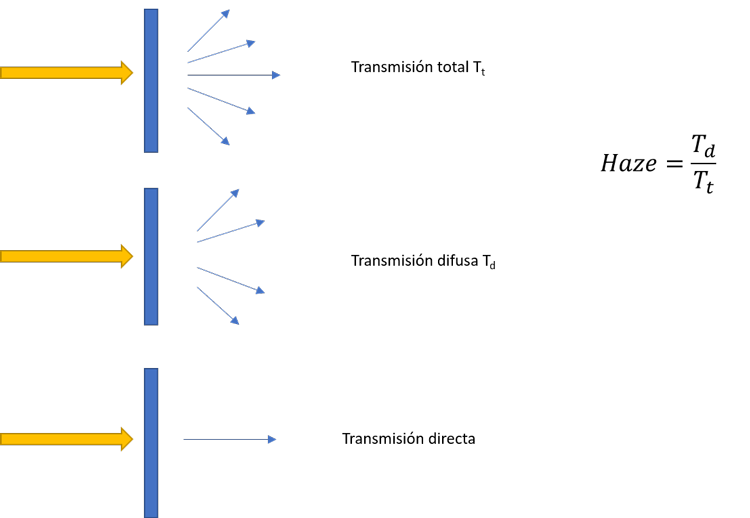
Haze refers to the scattering of light within a transparent polymer, giving it a cloudy or whitish appearance. This is the percentage of transmitted light that is scattered more than 2,5º from the direction of incidence of the beam.
More information about haze in this post: Measurement of Haze or turbidity in transparent materials
A high dispersion of light, that is, greater turbidity, can be interesting in sunny areas since it does not produce shadows under the greenhouse, while in less sunny areas it may be a priority to obtain maximum light transmission.
In the spectral transmittance curves for diffuse light, a difference can be seen between the exposed sample and the one that is not. The exposed sample generally presents greater diffusion, this could be due to the fact that exposure to environmental conditions causes the surface to present more irregularities and dirt (stains due to rain). Although the exposed sample has been cleaned prior to testing.
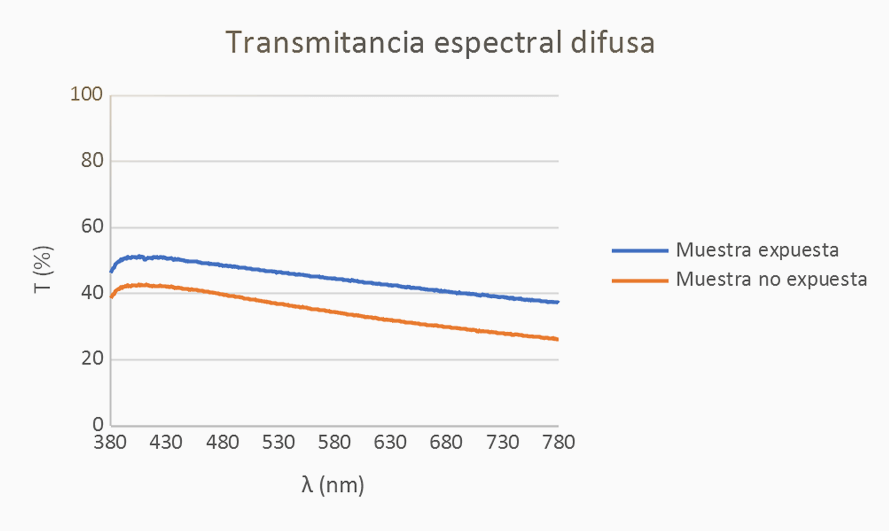
This difference is also observed in the Haze value, where the exposed sample presents higher values.
| Tt(%) | Td(%) | haze(%) | |||||||||||||
| Exposed sample | 85,1 | 44,7 | 52,6 | ||||||||||||
| Unexposed sample | 85,2 | 34,8 | 40,8 |
| Exposed sample Tt(%):85,1 Td(%):44,7 Haze(%):52,6 |
| Unexposed sample Tt(%):85,2 Td(%):34,8 Haze(%):40,8 |
For this reason, it is important to control the effect of environmental conditions through accelerated aging tests, where the optical properties are evaluated before and after aging.
Effectiveness against IR radiation: thermicity
The effectiveness against IR radiation is a parameter that indicates the transmission of light in the IR spectrum, specifically in the interval between 1430 cm-1 to 770 cm-1 of wave number (wavelengths between 7 µm and 13 µm) that corresponds to the field of maximum emission of the energy radiated by the earth's surface.
This is a parameter of interest in these plastics since in the construction of greenhouses it is important to provide controlled transparency to two main types of radiation, on the one hand, the solar radiation emission band (which is tested with the determination of the transmission of visible light) and the terrestrial radiation emission band for the purpose of controlling the temperature inside the greenhouse.
Therefore, for a thermal film that is going to be used in a greenhouse for these purposes, it must be determined that it meets the requirements of effectiveness against IR radiation, so that it allows the IR radiation spectrum of interest to pass. A high effectiveness against IR radiation indicates high transmissibility of IR rays.
The determination of the effectiveness against IR radiation or thermicity is measured with a FTIR spectrophotometer.
The FTIR spectrophotometers (Fourier-transform infrared spectroscopy) are based on the interaction of infrared radiation with matter. The operating principle is the usual one in spectrophotometers: radiation of a certain wavelength is directed onto the sample and the radiation that is transmitted or absorbed is evaluated.
| Radiation effectiveness | |
| Exposed sample | 82,86 % |
| Unexposed sample | 84,76 % |
| Exposed sample Effectiveness against radiation: 82,86% |
| Unexposed sample Effectiveness against radiation: 84,76% |
At Laboratorios Eyco we carry out the measure of effectiveness against IR radiation.
Types of plastic films for greenhouse covers
According to the UNE-EN 13206:2017 standard, there are three types of plastic films for greenhouse covers, according to their characteristics:
| Type | Optical and thermal characteristics | Use |
| Non-thermal (NTh) | Low effectiveness against IR radiation | Forced and semi-forced crops |
| Transparent thermal (ThC) | High transparency. High effectiveness against IR radiation | Same use as a normal film, when a high effectiveness against IR radiation is required |
| Diffuse thermal (ThD) | Light diffusion High effectiveness against IR radiation | Same use as a normal film, when high effectiveness against IR radiation and high light diffusion is required |
| Type:Non-thermal (NTh) Optical and thermal characteristics:Low effectiveness against IR radiation Usage: Forced and semi-forced crops |
| Type:Transparent Thermal (ThC) Optical and thermal characteristics: High transparency. High effectiveness against IR radiation Use: Same use as a normal film, when a high effectiveness against IR radiation is required |
| Type:Diffuse Thermal (ThD) Optical and thermal characteristics: Light diffusion High effectiveness against IR radiation Use: Same use as a normal film, when high effectiveness against IR radiation and high light diffusion is required |
Each of the types must meet specific requirements according to their classification and nominal thickness.
Optical requirements
Non-thermal films (NTh)
These films only need to meet requirements for visible light transmission and based on nominal film thickness. The visible light transmittance must be above 90% for thicknesses between 20 and 60 µm, and above 85% for thicknesses between 150 and 200 µm.

Thermal films (ThC)
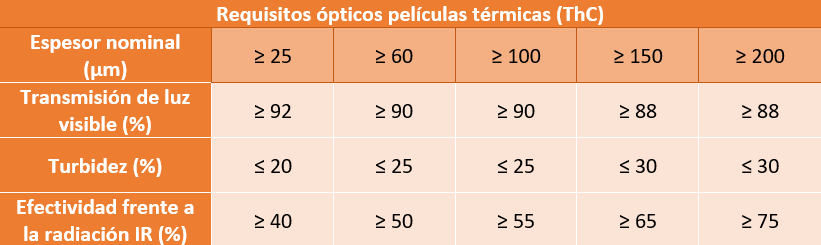
For transparent thermal films the requirements extend from visible light transmission to haze and effectiveness against infrared (IR) radiation.
The most striking in these requirements is that although the effectiveness against IR radiation is similar to diffuse thermal films, the turbidity in this case must not exceed 30% in any case.
Thermal diffuse films (ThD)
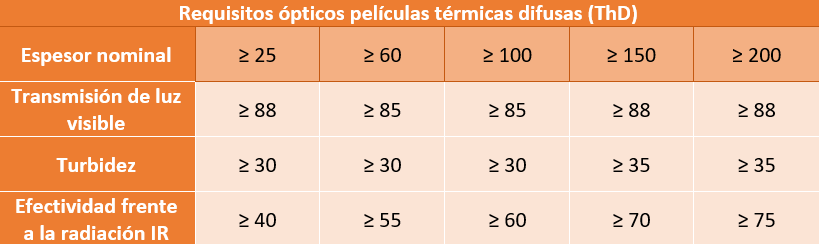
For diffuse thermal films, they have a haze greater than 30% and the visible light transmission requirements are lower.
Standardized tests in Laboratorios Eyco
Laboratorios Eyco carries out tests of the optical properties of plastics used in agriculture according to the UNE-EN 13206:2017 standard. We can carry out light transmission, turbidity and haze measurement tests in accordance with the provisions of the Standard.
For this we have integrating sphere spectrophotometers 150mm and with a range from 200nm to 2500nm. The dimension of the sphere makes it possible to ensure that the relationship between the size of the sample and the sphere will always conform to the standard.
Other standards that establish test methods for determining turbidity are the UNE-EN 2155-9, ASTM D 1003 e ISO 14782 .
Laboratory tests allow manufacturers to check whether their products conform to current standards.
FAQ
What standard regulates the optical properties of plastic films for greenhouses?
The reference standard is the UNE-EN 13206: 2017This European standard specifies the requirements applicable to thermoplastic plastic films for greenhouse covers and forced ventilation tunnels, defining both the mechanical and optical properties essential for their proper functioning.
What are the main optical properties that are evaluated in an agricultural plastic?
To ensure proper crop development and microclimate control, three fundamental parameters are evaluated: visible light transmission, the turbidity or light scattering (haze) and thermality (barrier effect against long-wave infrared radiation).
What is the difference between a transparent plastic film and a diffused one?
The difference lies in its level of turbidity (haze):
- The transparent films They allow light to pass through directly, which can cast intense shadows and cause burns if the sun shines strongly.
- The blurry films They disperse incoming light in multiple directions, achieving more uniform illumination that penetrates the crop canopy better and avoids light stress.
What is the thermal properties of a plastic film and why is it important?
La thermality It is the plastic's ability to retain the infrared radiation emitted by the soil and plants at night. A film with high thermal properties acts as an insulator, reducing heat loss to the outside, preventing temperature inversions, and protecting crops from frost.
Why is it necessary to analyze new plastics and exposed plastics?
Comparative analysis is key because plastic films degrade due to solar radiation, wind, and chemical agents. Eyco We evaluate both the original and exposed material to determine how aging affects light transmission and the loss of optical properties, which can help manufacturers ensure product quality and durability under real-world usage conditions.