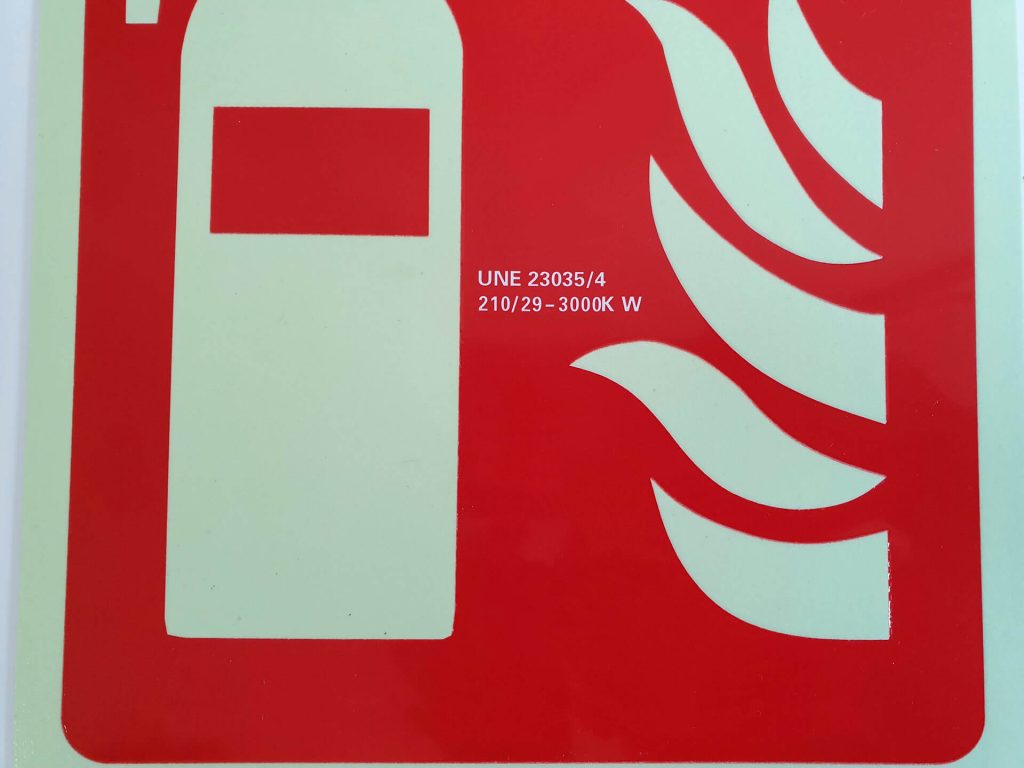
All photoluminescent signs They must contain a code that designates the pigment or product.
This code contains values that refer to the signal luminance at 10 minutes and 60 minutes after finishing the stimulation, the attenuation time, the color of said signal during stimulation and during attenuation, and the number of the standard.
That is, a code on a photoluminescent sign might have this designation:
60/7,8-900 – K – W/UNE 23 035
K, W values of the luminescent signals
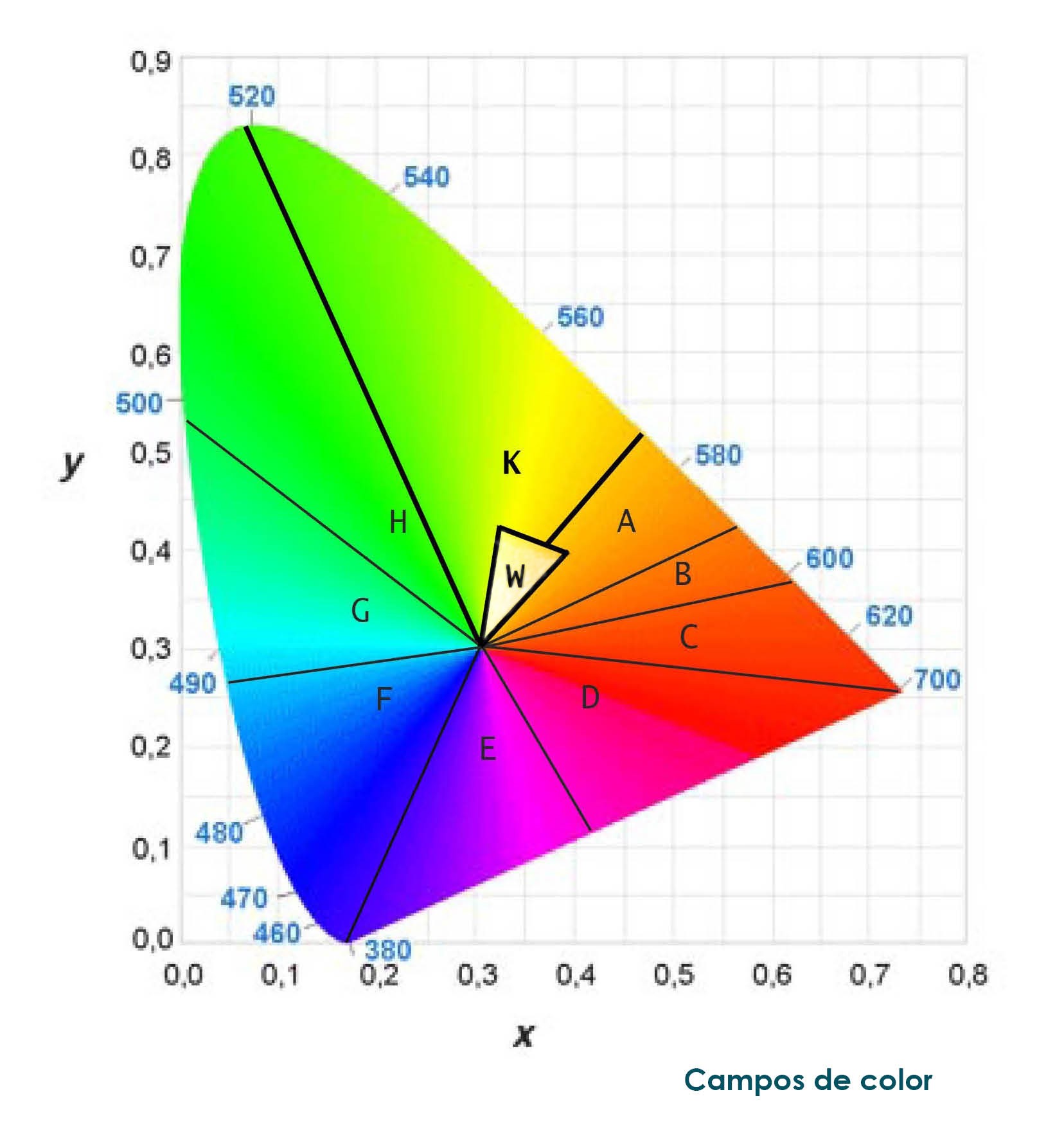
The K, W values that appear in the example above refer to the color of the signal during stimulation and during attenuation. In both cases, the color fields are those that correspond to the following image:
Specifically, the K value in this example indicates that the photoluminescent would have a greenish-yellow color (K), while the W value indicates that the pigment or photoluminescent product would have a white color (W). Color is measured under stimulation and attenuation conditions.
The manufacturer must guarantee that the color values indicated in the code that appears on the signal are actually those that the photoluminescent has in conditions of stimulation and rest.
The laboratory tests They allow us to determine the colors in both conditions., but the manufacturing conditions can affect these values, so the manufacturer must take the appropriate measures so that the labeling always corresponds to reality.
Rest of values
As for the rest of the values that appear in the code of the example, they designate the pigment or photoluminescent product according to:
- La luminance (measured in mcd/m2) at 10 minutes and 60 minutes after the end of the stimulation. In the example above, the pigment or product would have a luminance of 60mcd/m2 at 10 minutes after the end of stimulation, and 7.8 mcd/m2 at 60 minutes.
- El time of attenuation, which for the case we are exemplifying, would be 900 minutes.
- Finally, the designation also indicates the number of the standard. In this case, UNE 23 035.
Other signal colors
It is worth remembering that the colors of the sign that are not photoluminescent must also be measured to ensure that they meet the values required by Standard PNE 23033-1.
Thus, it must be taken into account that, with regard to safety related colors, there are normatively accepted chromatic regions and luminance factors, that is, chromatic limits have been determined for safety colors.
Laboratory tests allow the manufacturers check if your photoluminescent signage products They comply with current regulations.
FAQ
What do the K and W values measure in photoluminescent signals?
The values K (attenuation constant) y W (attenuation time) They measure the ability of a photoluminescent sign to store and emit light in the dark after the stimulation source ceases. These are the fundamental parameters for determining the category and quality of safety signage materials.
What exactly is the K value or attenuation constant?
El K value It represents the rate at which the luminance of the material decreases over time. An optimal attenuation constant ensures that the material maintains sufficient light intensity and decreases in a controlled manner to be visible in emergency situations.
What does the W value indicate in photoluminescent signage?
El value W It defines the total time (in minutes) it takes for the signal's luminance to drop to a minimum safety threshold (usually 0,32 mcd/m²). In other words, it indicates the signal's actual lifespan before becoming invisible to the human eye in total darkness.
What regulations govern the measurement of K and W values?
The measurement and classification of these values are governed by strict safety and lighting regulations. The main references that define the tests and minimum requirements are:
- The UNE 23035 (in Spain), which establishes the criteria for photoluminescent signaling systems.
- International standard ISO 16069, applicable to evacuation routes and safety components.
- The classifications of Category A (high luminance for public places or places without natural light) and Category B (lower luminance).
Why is it essential to test these values in an accredited laboratory?
Conduct the tests in a laboratory accredited by ENACCompanies like Eyco ensure maximum precision in optical measurements. Rigorous control of light excitation conditions and instrumental calibration guarantee that manufacturers and distributors comply with current regulations, providing absolute confidence in evacuation plans.