Gloss, in some cases, can be a determining property for a product in the consumer when evaluating it. In this way, measuring it to evaluate it in said products is important in quality control.
We indicate the important factors and aspects to consider about gloss:
What is gloss?
According to the Standard UNE-EN ISO 2813, who are "gloss is an optical property of a surface, characterized by its ability to reflect light specularly.«
El gloss It is an important attribute of objects and surfaces associated with our visual perception. Along with color, gloss is an essential parameter for evaluating the surface appearance of products. For this reason, the measurement of gloss is a common activity in the quality controls of production processes.
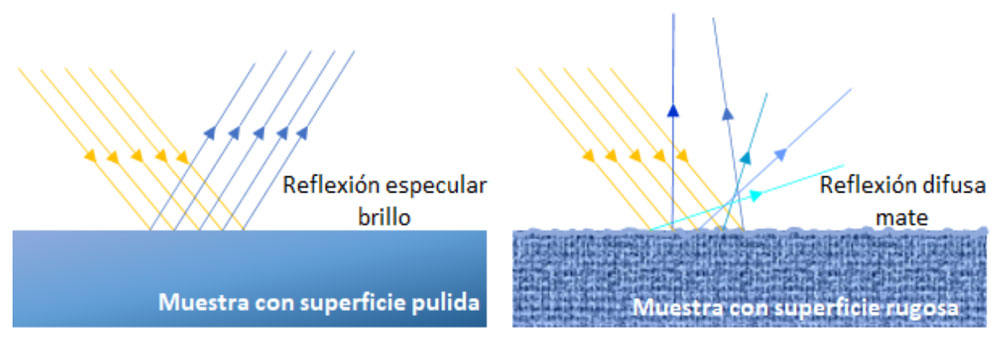
The perception of gloss is related to the finish of objects, with texture, roughness, etc. A smooth and polished surface produces a more shiny sensation than a rough surface.
The gloss of an object, product or surface can determine the acceptance or approval, or on the contrary the rejection, by consumers of said products or finishes. For this reason, it is important to carry out gloss evaluations objectively and quantitatively, using glossmeters. The use of the glossmeter is a common pattern in paint, varnish, plastic, automotive, etc. companies.
How is the gloss of an object measured?
When when light strikes a surface diffuse reflection and specular reflection occur. In diffuse reflection, the light rays go out in different directions, while in specular reflection, the light reflects in the same direction or at the same angle of incidence.
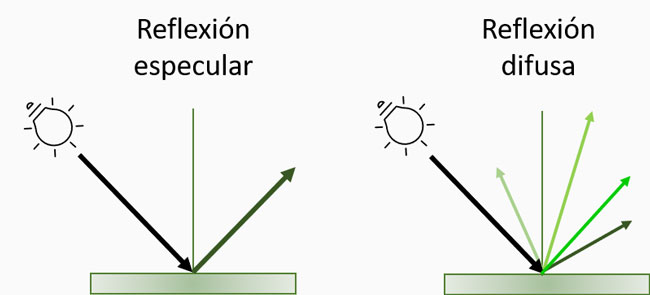
Diffuse reflection is responsible for color of objects while specular reflection is responsible for the gloss effect.
In materials with rough and non-smooth surfaces or finishes, the amount of diffuse light will be greater than direct or specular light, obtaining matte, low-gloss or semi-gloss surfaces.
While in polished and smooth finishes the proportion of direct light reflected is greater, because the light is directly reflected at the same angle of incidence, in this case we would have high-gloss surfaces or finishes.
In addition to the surface finish, there are other factors that also influence the gloss measurement. The angle of incidence and therefore the angle of observation, are one of them. The same surface or object does not present the same gloss if it is illuminated at an angle of 20º (with respect to the normal to the surface) as at 85º.
Therefore, the recommendations to choose the best gloss measurement geometry are as follows:
- Surfaces with high gloss: observation angle of 20º
- Surfaces with semi-gloss: observation angle of 60º
- Matt surfaces or with low gloss: observation angle of 85º
What is a glossmeter?
The physical principle for gloss measurement is the measurement of specular reflection from surfaces. And for this we use the glossmeters, Which are optical equipment that illuminates the object, sample or surface and evaluates the reflected light.
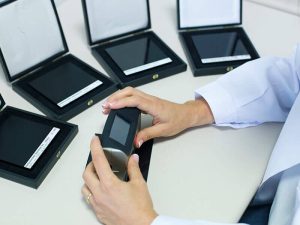
Glossmeters are reflectometric equipment that measure the specular reflectance of surfaces or products and return the measurement in gloss units: GU (Gloss Units). The glossmeter relates the visual perception of gloss to gloss units.
This GU scale is based on the specular reflectance for a given angle (20º, 60º and 85º) of a black glass material with a stated refractive index of 1.567, when illuminated with 587.6nm monochromatic light. The reflection under these conditions is assigned the value of 100GU.
It is important to note that the gloss unit scale, although based on the amount of light reflected, does not refer to a percentage nor can it be expressed as % reflection.
How does a glossmeter work?
As mentioned, the glossmeter or reflectometer measures the light reflected specularly, generally at angles of 20º, 60º and 85º.
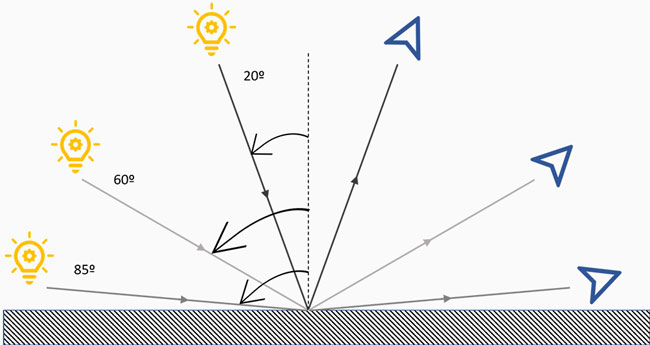
There are currently a wide variety of glossmeters on the market, some configured to measure the three geometries mentioned and others, with a simpler optical design, that measure gloss only at the 60º geometry.
Normally glossmeters are accompanied by a reference gloss standard. This standard is usually a high gloss polished black glass. This standard serves as a reference to the equipment when it is put into operation and to adjust the subsequent measurements made with the equipment.
These tuning standards indicate their value in gloss units for the different measurement geometries. For the correct use of the glossmeter, it is of the utmost importance that this gloss standard is kept in perfect condition and that when the adjustment is made, this standard is free of dust, scratches, fingerprints, etc.
Another aspect to consider when using a glossmeter is the direction of measurement, that is, the direction of the incident light. In some models of glossmeters a pictogram is included indicating the direction of measurement.
Glossmeter calibration
The glossmetersLike other measuring equipment, these instruments must be calibrated periodically to ensure measurement quality and traceability to internationally recognized reference standards. Furthermore, calibration must be performed for all measurement geometries used and for different brightness values.
The calibration frequency, for example annual, must be established by the user based on the use and the calibration history.
For this, it is recommended to resort to laboratories accredited by ENAC for the glossmeter calibration. The calibration laboratories will issue the Calibration certificate with mark ENAC, which guarantees that the calibration has been carried out by competent personnel and with recognized standards.
What are accredited calibration laboratories?
Accredited laboratories are those recognized by the National Accreditation Entity (ENAC), which work in accordance with the UNE-EN ISO/IEC 17025:2017 Standard, which includes the general requirements for the competence of testing and calibration laboratories.
The accredited laboratories are the only ones that provide the necessary confidence and guarantee in the results of their calibrations and tests.
What is a calibration certificate?
The Calibration certificate gives the correctness of the equipment together with its uncertainty. This correction is what the user must take into account in his routine measurements. The Calibration certificates for glossmeters issued by Laboratorios Eyco have the following characteristics:
- Complete equipment identification
- Procedure used and internal standards
- Correctness and uncertainty of the team.
From the correction values and their uncertainty, you can establish the acceptance and rejection values of the equipment.
Also along with your equipment you will receive a calibration label with the certificate number, equipment identification and calibration date.
Glossmeter Calibration Certificates are covered by the ENAC accreditation, therefore, it is not necessary to justify the traceability with the calibration certificates of the standards used.
To find out what you need to request a quote and calibration deadlines, please consult our website.
FAQ
Why is it important to take an accurate brightness measurement?
La brightness measurement It is a crucial factor in industrial quality control, since the visual appearance of a product directly influences consumer perception. Objectively measuring gloss allows for ensuring consistency in manufacturing processes, detecting surface defects, and guaranteeing that finishes strictly comply with the required aesthetic and functional standards.
What is a glossmeter and how does it work?
Un glossmeter It is an optical instrument designed to quantify the specular reflection of a surface. It works by projecting a beam of light at a specific intensity and angle onto the sample, and then measuring the amount of light reflected at the opposite angle using a photosensitive receiver. The results are generally expressed in Brightness Units (GU).
How to choose the right measurement geometry for each surface?
The choice of geometry or angle of measurement It depends on the brightness level of the surface to be analyzed, optimizing accuracy according to three main standards:
- Angle of 60°It is the standard and ideal geometry for medium gloss surfaces.
- Angle of 20°: It is used to evaluate high-gloss surfaces, such as lacquered or highly polished plastics.
- Angle of 85°It is intended for low-gloss or matte finish surfaces.
What technical aspects should be considered when measuring brightness?
To obtain repeatable measurements, it is essential to consider the sample homogeneityThe cleanliness of the surface and the stability of the ambient lighting are also important. Likewise, factors such as material roughness, part curvature, and the correct placement of the technical equipment on the test area directly influence the reliability of the data obtained.
Why is it necessary to calibrate gloss meters in laboratories accredited by ENAC?
Calibrate the equipment in a laboratory accredited by ENACAs Eyco does, it is essential to ensure the international metrological traceability of measurements. The periodic calibration of gloss meters and their reference standards guarantees the accuracy of optical instruments, reduces uncertainty in quality control tests, and provides legal and industrial validity to the results in demanding audits.