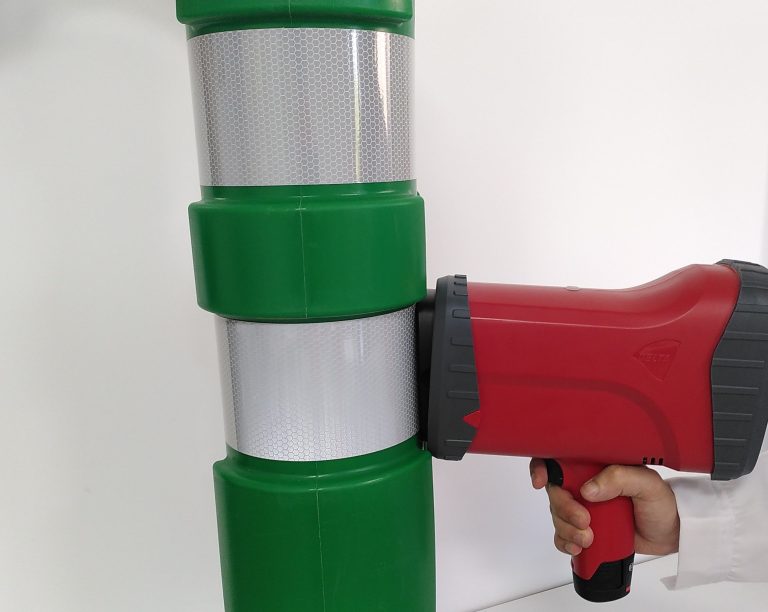
Retroreflectometer calibrations
On-site or laboratory calibration, with a personalized and flexible service. Delivery time: 5 days.
Calibration consists of establishing, under specific conditions, the relationship between the values measured by a piece of equipment and the reference values traceable to recognized standards.
This relationship allows the client to evaluate the instrument's performance and ensure the validity of its measurements, an essential process for guaranteeing road safety and visibility. The calibration focuses on handheld vertical retroreflectometers, ensuring the metrological traceability of results on key materials such as traffic signs, high-visibility clothing, license plates, and reflective tape.
Retroreflection calibration focuses on verifying the accuracy of the Retroreflection Coefficient (RA), which is the material's ability to reflect light in the direction of the driver. This process ensures the accuracy of key parameters measured by the equipment, such as the viewing angle (α) and the illumination angle (β), and is used by manufacturers and road safety organizations to assess the level of retroreflectivity (RA ). It complies with the minimum specifications required by the regulations.
What equipment do we calibrate?
Handheld Vertical Retroreflectometers We calibrate portable instruments used to perform objective retroreflection measurements in both field and production environments. These devices are essential for measuring the visibility of materials used in traffic signs, high-visibility clothing, license plates, and reflective tapes.
Why Is This Important?
The calibration of retroreflectometers is an essential measure for road and workplace safety, as it ensures that reflective materials meet the minimum night visibility standards required by regulations.
Ensuring accuracy in the measurement of the Retroreflection Coefficient (RA) allows manufacturers to certify the quality of traffic signs, license plates and high-visibility clothing, preventing accidents.
Furthermore, periodic calibration is essential to maintain metrological traceability, ensure regulatory compliance, and guarantee the reliability of measurements performed both in the laboratory and in the field. in situ over time.
Which retroreflectometers can we calibrate?
Eyco's calibration service for retroreflectometers covers various colors and all kinds of retroreflective materials, as well as those that exhibit fluorescence.
Eyco can calibrate retroreflectometers that meet the specifications of the Standards:
- UNE-EN 12899, Fixed vertical road signs. Part 1: Fixed signs. Part 3: Delineators and retroreflective devices.
- UNE-EN ISO 20471, High visibility clothing. Test methods and requirements.
- ASTM E 1709, Standard Test Method for Measurement of Retroreflective Signs Using a Portable Retroreflectometer at a 0.2 Degree Observation Angle.
- ASTM E 2540, Standard Test Method for Measurement of Retroreflective Signs Using a Portable Retroreflectometer at a 0.5 Degree Observation Angle.
- ASTM E 1809, Standard Test Method for Measurement of High-Visibility Retroreflective-Clothing Marking Material Using a Portable Retroreflectometer.
| Measurement range Range | Uncertainty (*) -- | Standard/Procedure -- | Instruments to be calibrated Instruments | Dress Code |
|---|---|---|---|---|
| Retroreflection (RA) Retroreflection (RA) | ||||
| 80 (cd lx-1· m-2)≤RA≤600(cd lx-1· m-2)α=0,33º; β=5º | ± 3% | EN 12899 UNE EN ISO 20471 | Vertical retroreflectometers | A,I |
The result
Once your equipment has been calibrated by Eyco's expert staff, you will receive a Calibration Certificate.
This Certificate includes the full identification of your equipment, the procedure the laboratory followed to perform the calibration, and the result of the calibration.
The calibration result is a correction along with its uncertainty. This correction is the difference between the value of the reference standard and the value measured by your equipment. The Calibration Certificate issued by Eyco will provide the retroreflection coefficient correction for six standards.
Based on the correction values and their uncertainty, you can establish the acceptance and rejection values for the equipment.
In addition, along with your equipment, you will receive a calibration label with the certificate number, the identification of the equipment and the date of calibration.