Absorbance/transmittance calibrations
On-site or laboratory calibration, with a personalized and flexible service. Delivery time: 5 days.
Calibration consists of establishing, under specific conditions, the relationship between the values measured by a piece of equipment and the reference values traceable to recognized standards.
This relationship allows the client to evaluate the instrument's performance and ensure the validity of its measurements, a fundamental aspect of quality control, especially in the chemical, healthcare, and agri-food sectors. Calibration is performed on equipment and standards that measure the absorbance and transmittance of materials, guaranteeing the metrological traceability of results in the UV-Visible and Near-Infrared (NIR) ranges.
Transmittance Calibration Transmittance is the fraction or percentage of incident light that passes through a sample at given wavelengths. Its calibration involves determining the accuracy of this measurement, which allows us to evaluate whether a material transmits UV light, its transparency in the visible spectrum, or the color of translucent materials.
Absorbance (Optical Density) Calibration Absorbance (or optical density, or OD) is the amount of light absorbed by a material. This quantity is commonly used in the application of the Lambert-Beer Law, allowing a direct relationship to be established with the concentration of an analyte, an essential process in chemical and biological analyses.
What equipment do we calibrate?
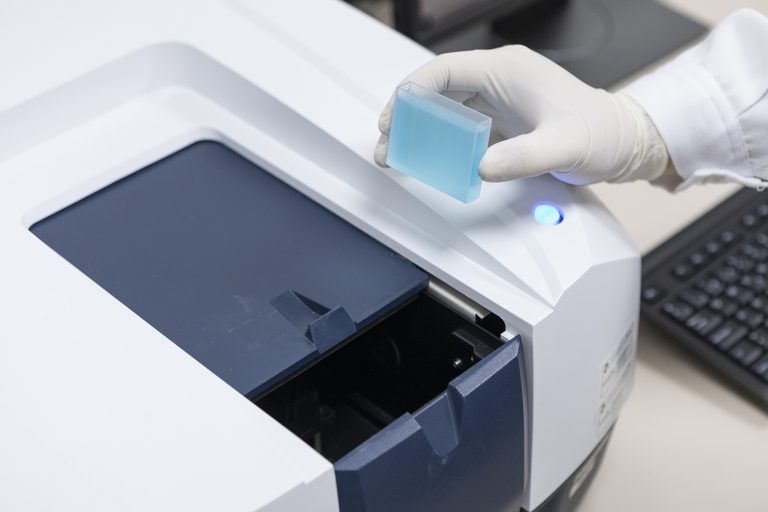
UV-Visible and NIR Spectrophotometers We calibrate spectrophotometers, both portable and benchtop, by evaluating the light absorbed, transmitted, or reflected by solid or liquid materials for each wavelength. Our accreditation ENAC It covers the wavelength scale, the photometric scale (absorbance/transmittance) and diffuse light in the UV-Visible range (220 nm to 780 nm).
We are the only laboratory in Spain with ENAC accreditation to calibrate the NIR (Near Infrared) zone from 780 nm to 2500 nm.
Microplate Readers (ELISA) These instruments, also called ELISA spectrophotometers, detect biological processes by measuring absorbance. We calibrate both the wavelength scale (monochromator) and the detector scale in absorbance.
Reference Standards and FiltersWe calibrate the reference instrumentation used for the verification, intercomparison, or internal calibration of spectrophotometers:
- Wavelength Filters: Filters of holmium and didymium oxide (solids or liquids). We calibrate the wavelength in the UV-Visible range and in the Infrared (780 nm to 2000 nm).
- Absorbance/Transmittance Filters: Neutral density glasses neutral densityWe calibrate in the UV-Visible range and in the Infrared (780 nm to 2000 nm).
- Filters for Linearity Calibration: Solutions (such as potassium dichromate) to evaluate the accuracy of the equipment based on the concentration.
- Filters for stray light calibration: They are useful for evaluating whether the detector is receiving light of a different wavelength than the one it requires.
- Standard Microplates: Used for calibrating the wavelength scale and the photometric scale in microplate readers.
Why Is This Important?
The calibration of absorbance and transmittance is a fundamental pillar for reliability in chemical, biological and materials analysis, being an unavoidable requirement in some sectors.
The certificate
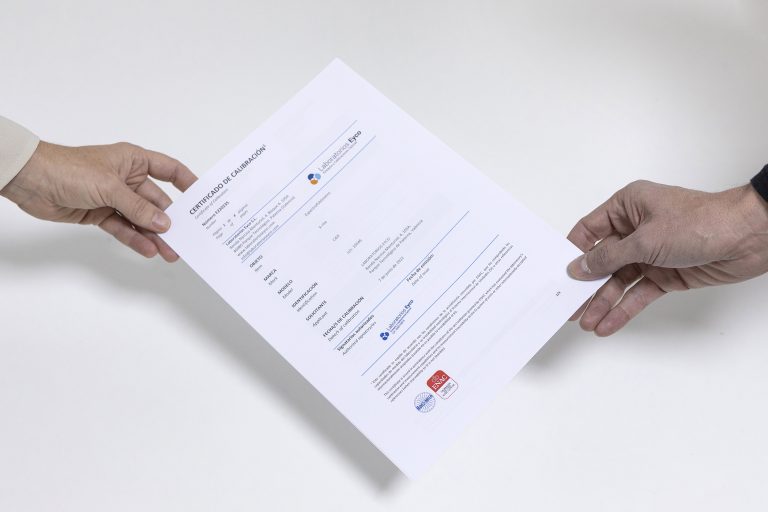
Once your equipment has been calibrated by Eyco's expert staff, you will receive a Calibration Certificate backed by ENAC accreditation. This certificate includes the complete identification of your equipment, the calibration procedure followed by the laboratory, and the calibration result.