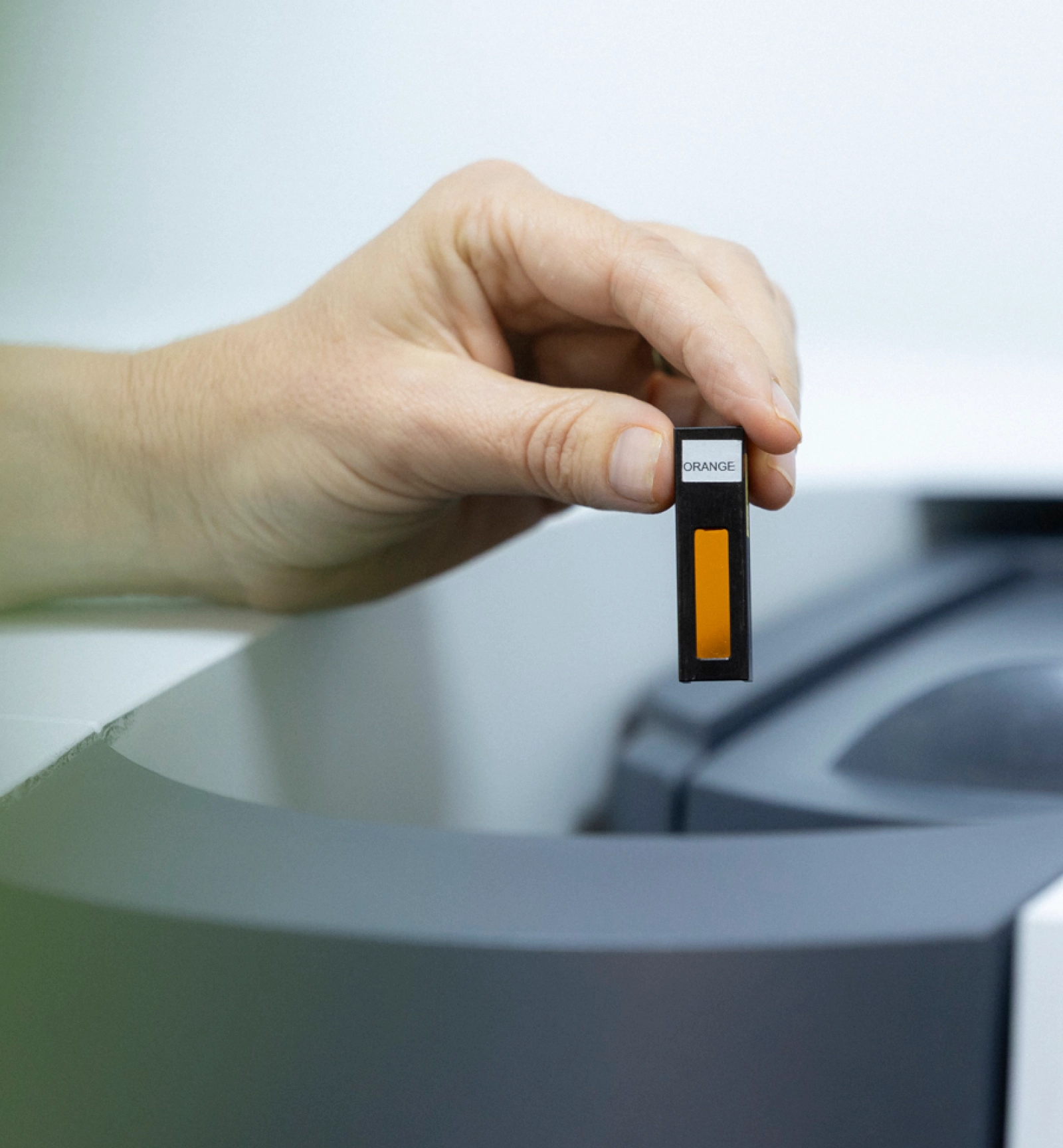
Calibrations of transmission spectrophotometers and colorimeters
On-site or laboratory calibration, with a personalized and flexible service. Delivery time: 5 days.
What do we calibrate?
Calibration of transmission spectrophotometers.
ENAC accredited calibration service.
Calibration of the measurement accuracy of the L color coordinatesab* or Yxy or tristimulus values for 6 points.
Calibration can be performed for one or more measurement conditions.
Each calibration condition It is defined as a specific combination of:
- a measurement geometry (0º:45º, 8º:di or 8º:de),
- an illuminant (A, C, D50 or D65),
- and an observer (2nd or 10th).
Determination of the repeatability of the equipment on a standard.
Color evaluation in transmission
Color control is a fundamental variable in numerous industrial sectors. In certain industries, this need extends specifically to the chromatic characterization of translucent solids and liquids. For this purpose, the industry uses evaluations based on the spectral transmittance of the material. Spectrophotometers and transmission colorimeters are employed for this purpose.
These measuring instruments are used by various industrial sectors and companies that manufacture a wide range of products, such as glass, plastics, food, paints, cosmetics, hygiene and cleaning products, as well as other applications within the chemical sector.
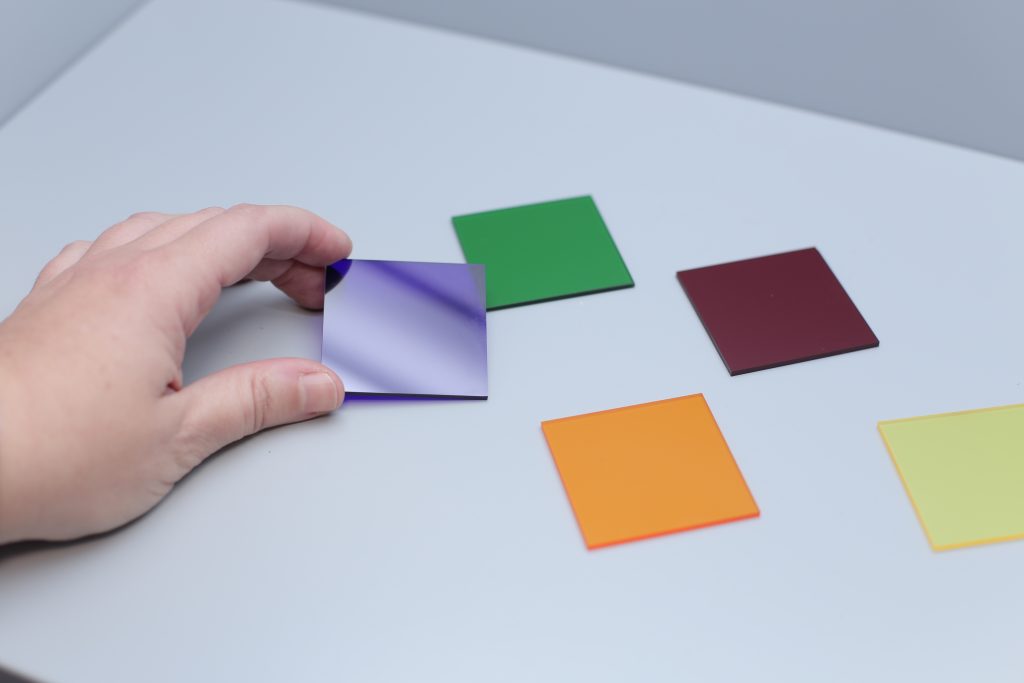
Transmission Colorimeters and Spectrophotometers
Spectrophotometers and transmission colorimeters are used to determine the color of translucent solids and liquids. Specifically, color evaluation is performed by obtaining the spectral transmittance data corresponding to the sample or material being analyzed.
Depending on the characteristics of the material, regular or diffuse transmittance measurements can be performed, with specular component included and excluded.
Color in transparent, translucent and opaque samples
The psychophysical phenomenon of color perception requires consideration of various elements: the light source (or illuminant), the observer, the measurement geometry, and the object being evaluated.
Regarding the object, it is essential to consider that light radiation undergoes modifications through physical processes such as reflection, transmission, absorption, scattering, interference, and diffraction. These phenomena occur in specific proportions depending on the properties of each material. Thus, based on their behavior in response to incoming light, objects can be classified as transparent, translucent, and opaque.
In opaque bodies, which prevent the passage of light, color is characterized by light reflectance.
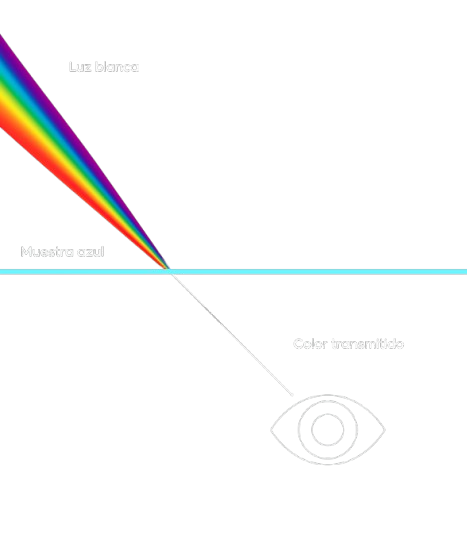
Conversely, in the case of translucent and transparent objects, the perceived color is determined by light transmission. Translucent objects allow light to pass through but do not allow objects behind them to be seen. Transparent objects, on the other hand, not only allow light to pass through but also allow objects on the other side to be seen clearly.
In the image below we can see a representation of a translucent body interacting with light.

Color measurement conditions
Color is the result of the interaction of radiation (light/illuminant) with an object, detected by a detector (observer) and taking into account the way in which light interacts with the object (geometry).
Therefore, to measure color, one must know the measurement conditions: the geometry, the illuminant, and the observer.
Eyco is the only laboratory in Spain accredited for the calibration of equipment that measures chromatic coordinates and tristimulus values in transmission.
Geometry
Geometry 0º:0º and 0º:di. Transmission color can be measured in 0º:0º and 0º:di geometries. These geometries are used in transmission colorimeters, both for the measurement of liquids and translucent solids (glass, plastic, etc.).
Observer
La CIE has standardized the types of observers (2nd and 10th), each of them representing a different visual field.
It is usually more common for companies to carry out measurements under the condition of 10º observer, although this depends on the type of sector and industrial activity.
Illuminant
The spectral distribution curve of the light sources is the illuminant. That is, it is the type of light that falls on the sample to be measured.
It is common to use illuminants D65, D50, A, and C. Thus, while daylight corresponds to illuminants D65 and D50, incandescent artificial light is simulated by illuminant A.
On the other hand, there are also illuminants that refer to fluorescent light sources. The latter are usually used for very specific applications or for test regulations that indicate the use of these illuminants.
Technical scope for the calibration of spectrophotometers and transmission colorimeters
Eyco is ENAC accredited for the calibration of transmission spectrophotometers:
| Measurement range Range | Uncertainty (*) -- | Standard/Procedure -- | Instruments to be calibrated Instruments | Dress Code |
|---|---|---|---|---|
| Color, coordinates L*a*b*Y xy; Tristimulus values X,Y, Z (0º:0º and 0º:di) Color, coordinates L*a*b*Y xy; Tristimulus values X,Y, Z (0º:0º and 0º:di) | ||||
| 0≤ L≤ 100 -150 ≤ a ≤ 150 -150 ≤ b* ≤ 150 0≤X≤100 0 ≤ Y ≤ 100 0≤ Z≤ 100 0,1000 ≤ x ≤ 0,9000 0,1000 ≤ y ≤ 0,9000 | 0,20 0,50 0,50 0,20 0,20 0,20 0,0020 0,0020 | PT40 Procedure internal based on: IUPAC Recommended Reference Materials for realization of Physicochemical properties CIE 15 | Spectrophotometers | A,I |
The result
Once your equipment has been calibrated by Eyco's expert staff, you will receive a Calibration Certificate backed by accreditation. ENAC.
Said certificate includes the complete identification of your equipment, the procedure that the laboratory has followed to carry out the calibration and the result of the same.
The calibration result is a correction along with its uncertainty. This correction is the difference between the value of the reference standard and the value measured by your equipment. The Calibration Certificate issued by Eyco will provide the chromaticity coordinate correction for six standards.
Based on the correction values and their uncertainty, you can establish the acceptance and rejection values for the equipment.
In addition, together with your equipment, you will receive a calibration label with the certificate number, the identification of the equipment and the date of calibration.