Properly defining color tolerances is crucial to ensure quality and avoid high costs.
Color accuracy is critical in many industries, from printing to construction. However, the key to guaranteeing consistent and satisfactory results lies not only in the instrument precision used to measure color, but also in clearly defining color tolerances.
In this post, we will explore various aspects related to color tolerances. We'll start by defining what exactly color tolerances are and why they are so important in various industrial sectors. We will also talk about the cost that ambiguity can bring in the definition of tolerances, as well as the problems that arise when they are not established clearly and precisely. Finally, we will examine the crucial role that testing laboratories play in color evaluation, especially when discrepancies are detected between established standards and the results obtained.
What are color tolerances?
Color tolerances are defined as the acceptable limits of variation in the color of an object compared to a predefined reference standard. This standard can be established by organizations such as the International Commission on Illumination (CIE) or can be specified by the client according to their specific needs.
To better understand color tolerances, it is essential to become familiar with the CIE Lab* color space. This model describes color in terms of: luminosity (L*), red-green hue (a*) and blue-yellow hue (b*). Each component has a numerical range, with positive and negative values indicating the color of an object within the color space.

Color variations, for their part, are defined from the differences between the measured value for each coordinate and its reference value, as follows:
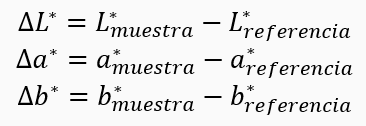
Similarly, it defines a color difference total ΔE* which is given by:

When you set color tolerances, you define the limits within which an object is considered to match the reference standard. Thus, for example, in the industry print, very strict color tolerances can be specified to ensure accurate image reproduction. If the color of a print is within these limits, it is considered acceptable; Otherwise, it is considered out of specification and may require adjustments to the printing process.
Practical example: Color tolerances in the application of paints to different materials
Let's look at an illustrative practical example. Suppose that a company painting develops a new color and wants to apply it to various materials, including wood, metal and plastic, for use in the furniture industry. To maintain color consistency across all substrates, it is imperative to establish clear and realistic color tolerances from the beginning, as the variety of substrates (with different textures, porosity and composition) can significantly affect the result.
Thus, the company establishes color tolerances using the CIELab* system. They define what variation in the values of L*, a* and b* can be the maximum to guarantee perceptible color uniformity between different materials. For example, they could specify that the color difference total ΔE* must be less than 1.5 to consider that a sample meets the established standards.
During the production process, paint samples are applied to each substrate and color measurements are made using calibrated spectrophotometers. These measurements provide accurate data on the color of each sample in terms of the values of L*, a* and b*.
If any sample does not meet established color tolerances, adjustments can be made to the paint formulation, application process, or both, to correct the discrepancy and ensure consistent color reproduction on all substrates.
The cost of ambiguity
Failure to clearly define color tolerances may seem like a trivial decision, but it can actually have significant repercussions for a company. The lack of specificity in this aspect can translate into high long-term costs.

Problems with not defining color tolerances
Some of the problems that can arise due to not defining color tolerances are the following:
- Inconsistency in production: Without clear boundaries, color can be interpreted subjectively, leading to unwanted variability in production.
- Product rejection: Failure to agree on color standards can result in products that do not meet customer expectations, leading to returns, complaints, and loss of brand trust.
- Production Delays – Lack of definition can lead to disputes and production delays while quality issues are resolved.
- Rework Costs: Correcting nonconforming products can be costly and time-consuming, especially if discovered late in the manufacturing process.
The critical role of testing laboratories
The accredited testing laboratories They are specialized entities that have the equipment and knowledge necessary to perform accurate color evaluations. Additionally, the results reports generated by these laboratories are detailed and comprehensive, providing companies with a clear understanding of any deviations from established color tolerances.
These laboratories have the ability to identify and quantify any color discrepancies and provide recommendations to correct any deviations. Furthermore, they can evaluate color on final products to verify whether agreed color tolerances have been met. This gives companies and their customers confidence that products meet expected quality standards and helps avoid subsequent claims.
In summary, accredited testing laboratories play an essential role in ensuring color consistency and accuracy across various industrial sectors.
FAQ
What are color tolerances in the industrial sector?
color tolerances They define the maximum permissible color variation between a sample and its reference standard. Establishing these limits mathematically allows for an objective determination of whether a product's color is acceptable or should be rejected during quality control.
Why is it critical to define color tolerances accurately?
Defining clear boundaries eliminates the subjectivity of human perceptionThis tolerance is affected by factors such as lighting, eye strain, and the environment. By standardizing tolerance, sectors such as textiles, plastics, automotive, and printing mitigate trade disputes, reduce returns, and avoid costly delays in production chains.
What role do the CIELab color space and the calculation of ΔE* play?
Space CIELab It organizes color using three essential mathematical coordinates: lightness (L*), red-green axis (a*), and yellow-blue axis (b*). The total difference between two samples is quantified using the formula for ΔE*The lower this value, the more identical the evaluated colors will be.
What methodologies and formulas are used to evaluate these tolerances?
Over time, colorimetry has evolved to develop equations that better match the sensitivity of the human eye. The main methodologies include:
- The classic formula CIELAB 1976 (ΔE*), which calculates the geometric distance in three-dimensional space.
- The mathematical equation CMC (l:c), widely used in the textile industry to assess acceptability.
- The international standard ICD94, which introduces weighting factors for clarity, chroma, and hue.
- The advanced formula CIEDE2000 (ΔE*), the most accurate method currently available for correcting deviations in visual uniformity of the eye.
How does a testing laboratory help to ensure color consistency?
A laboratory specializing in optical properties such as Eyco It provides the essential analytical tools for reliably measuring color on any type of substrate. Using calibrated spectrophotometers and standardized methodologies, the laboratory helps companies define their tolerances, audit their suppliers, and ensure maximum brand loyalty and consistency in the market.