The cosmetic industry carries out exhaustive examinations of optical properties to guarantee the quality of its products.
The cosmetics industry, driven by the demand for aesthetically pleasing and high-quality products, conducts rigorous testing of optical properties to ensure the consistency and efficacy of its products. Since the color measurement to gloss evaluation, manufacturers use a variety of advanced equipment to ensure that each product meets the most exacting standards.
In this publication, we address the particularities of the color and appearance measurements in the cosmetic industry, focusing on color measurements in both opaque solids, translucent solids as in liquidsas well as in brightness measurements. We also talked about the visual color comparison and we mention other tests used in the cosmetic sector, such as the Farnsworth-Munsell 100 Test. In addition, we show some results of measurements carried out on cosmetic products.
Particularities of color and appearance measurements in the cosmetics industry.
In the cosmetic industry, equipment Measurement methods selected to evaluate appearance vary depending on the information to be obtained, whether the color itself, the appearance, the gloss or the effects. Additionally, it is common to measure products both in their original form and once applied, or even combine both measurements to obtain a more complete evaluation.
As is well known, cosmetic products exhibit various textures, such as powders, creams, enamels and lotions or perfumes, and their color, shine and appearance They can change significantly before and after application. Furthermore, another factor that must be taken into account is the degree of opacity, which determines how a material interacts with light, ranging from total absorption (opaque) to complete transmission (transparent).
For example, lipsticks are usually opaque in their original form, but may have different levels of transparency, translucency, or opacity once applied. Additionally, brightness is a crucial factor as it can vary depending on the viewing angle and the type of pigment used. Therefore, the appearance of the lipstick is controlled in three states: the color of the mass (without shine), the color of the stick (as seen on the packaging) and the color in use (once applied to the lips). Another example of color control in cosmetics are perfumes and lotions, which are usually transparent solutions and are verified in a solid state, controlling both their color in the vat and their general appearance in the final container.
Color and appearance measurements in cosmetics.
Color
Color is not a property of materials, but the result of how light interacts with an object and is perceived by the observer. It is defined as a psychophysical experience, since it is the psychological response to light that our retinal cells specialized in different wavelengths detect.
La color measurement It is a scientific technique that allows us to quantify the perceived color of an object or substance. It can be applied to a variety of forms and states of matter, including opaque solids, translucent solids and liquids. This measurement is carried out using specialized instruments such as colorimeters y UV-Vis spectrophotometers, which capture precise data about the way light interacts with the object.
Color measurement in opaque solids.
The guidelines of the ICD No. 15 address the determination of CIE chromatic coordinates in different geometric configurations, specifically in 0º:di, 0º:de, 0º:45ºa geometry. Additionally, they establish how to evaluate color differences using the CIELAB system in the same geometries.
In cosmetic products opaque solids, such as eye shadows, powders and lipsticks, color is generally measured by reflectance. Reflectance spectrophotometers illuminate the sample with light of known intensity and measure the amount of light reflected at different wavelengths.
Measurement of color in translucent solids and liquids.
To measure color in translucent solids and liquids, is evaluated from the spectral transmittance data of the material. Depending on the type of material, the transmittance measurement can be performed in a regular or diffuse manner, including or excluding the specular component.
Examples of color measurements in cosmetic products.
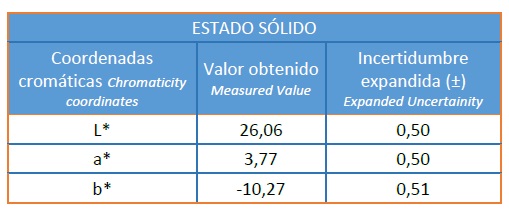
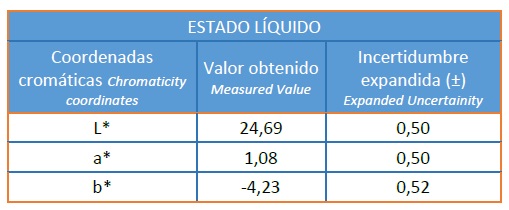
Below are results of a test carried out on a cosmetic product. The purpose of the test was to determine the color of said product in both states, and it was carried out following a technical procedure based on the CIE 15.
Bright
El gloss It is a visual effect or perception of a surface when light hits and is reflected in a certain way. Talking about brightness, therefore, also means talking about the reflection of light.
There are two types of reflection: diffuse, where light is dispersed in several directions, and specular, where light is reflected in a single direction following the angle of incidence. To evaluate the brightness, it is measured at different angles, such as 20º, 60º and 85º.
Cosmetic applications feature chromatic attributes, such as hue and clarity, and geometric attributes, such as shine and reflections. This results in a wide range of visual effects, influenced by transparency, diffusion, special pigments and variations in gloss.
To analyze these effects, measurement technologies are used that evaluate aspects such as image sharpness (DOI), specular brightness, and contrast brightness. Furthermore, digital imaging technologies and multi-angle spectrophotometers They offer the most detailed information on how the distribution of reflected light on the cosmetic varies.
A multi-angle spectrophotometer, or gonium-spectrophotometer, measures color from a specific lighting angle and multiple viewing angles. This equipment is essential for materials that show visual changes depending on the angle from which they are viewed. These spectrophotometers consider the measurement geometry, light type, and observer to provide a complete color evaluation.
Examples of gloss measurements in cosmetic products.
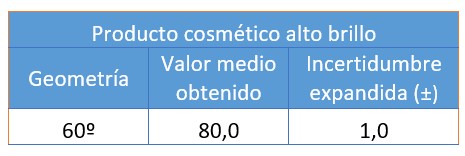
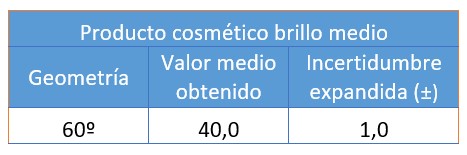
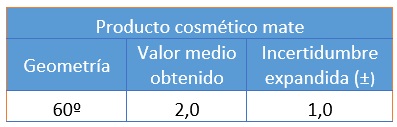
Below are the results of a trial conducted for determine the specular brightness index at 60º of three cosmetic products: one with high shine, another with medium shine and the last matte.
Visual color comparison
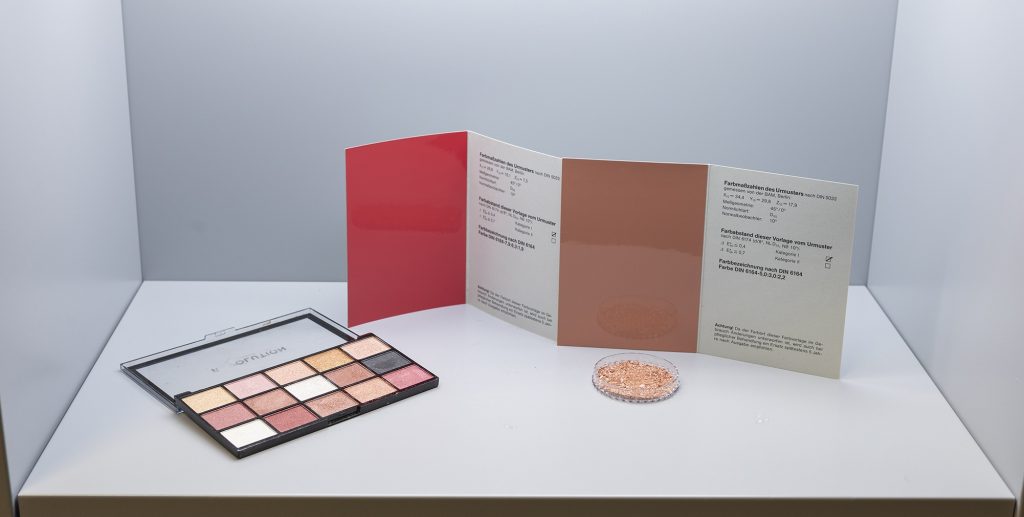
In the cosmetic industry, the visual color comparison plays a crucial role in creating products that meet consumer expectations. The light boothsColor booths, specifically designed for color evaluation, are essential tools in this process. These booths are equipped with standardized light sources that simulate different lighting conditions, such as sunlight, tungsten light, or fluorescent light. This allows manufacturers and colorists to observe how product colors behave under various conditions, ensuring that the color appears consistent and appealing in all situations.
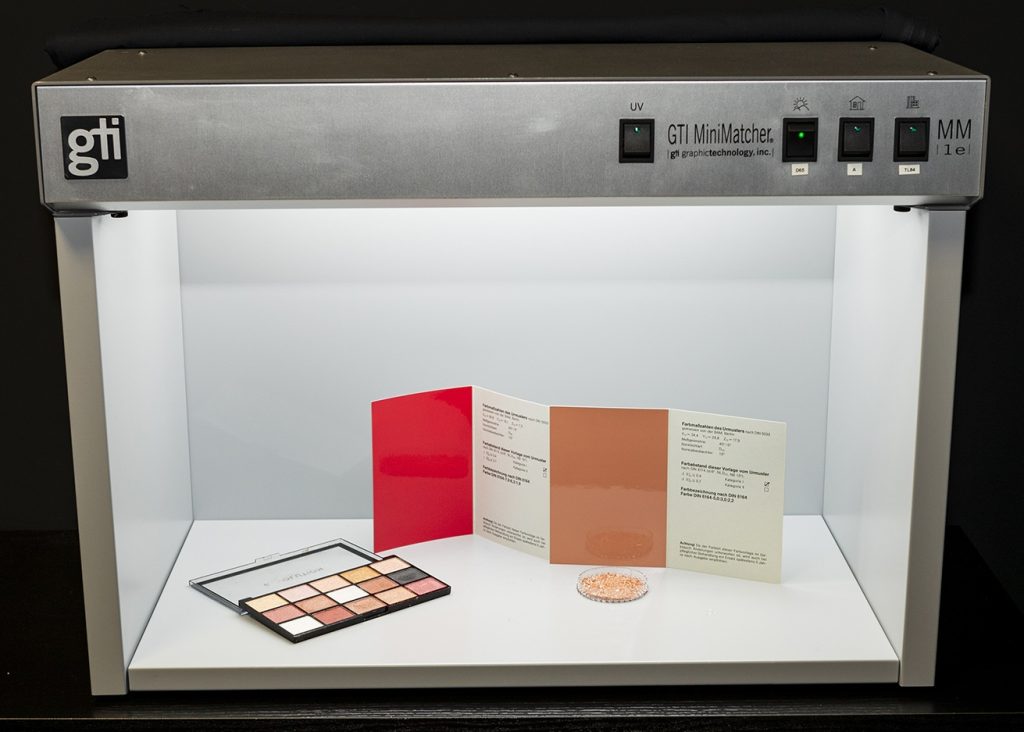
Accurate color visualization is essential to avoid discrepancies and ensure a satisfactory user experience. Light booths help identify subtle color variations that might not be apparent under standard lighting. By providing a uniform and controlled evaluation, these tools allow professionals to adjust formulas and packaging to align with market expectations and consumer preferences.
Other tests. Farnsworth-Munsell 100 test
The Farnsworth-Munsell 100 Hue Test is a psychometric assessment designed to measure color discrimination ability. Created by psychologist Farnsworth and scientist Munsell, this test consists of a series of 85 color discs that the subject must organize in a continuous chromatic order, from the lightest to the darkest, based on shades of hue. The objective is to evaluate the precision with which a person can distinguish between different shades and saturations, allowing the identification of deficiencies in color perception that could be indicative of specific visual conditions, such as color blindness or chromatic dyslexia.
The Farnsworth-Munsell 100 Hue Test is used in cosmetics, since accurate perception of shades is crucial. By providing a quantitative measure of color differentiation ability, this test helps ensure that professionals in these areas can make precise adjustments to their work, thus ensuring quality and fidelity in color reproduction.
Eyco
At Eyco, we have ENAC accreditation for the calibration of equipment used in the cosmetic sector. Among them, colorimeters, spectrophotometers, UV spectrophotometers, glossmeters, multi-angle spectrophotometers y visual color comparison cameras.
Furthermore, at Eyco we have ENAC accreditation to carry out color and appearance tests. Specifically, we are accredited ENAC to carry out color measurement tests in opaque solids, following the regulations UNES EN ISO 17025:2017 standard and the guidelines of the ICD No. 15. We offer the determination of CIE chromatic coordinates in 0º, 0º, 0º:45ºa geometry, as well as the determination of color differences using the CIELAB system in the same geometries. In addition, we also offer testing services in translucent solids and liquids, in accordance with the guidelines of the ICD No. 15, in 0º:0º geometry, 0º for color determination and color differences.
In addition, our laboratory is qualified to carry out testing of gloss evaluation for the three geometries (angle of incidence and angle of observation) at 20º, 60º and 85º, according to different international regulations.
FAQ
Why is it essential to control color and optical properties in the cosmetics industry?
Control of color, brightness and opacity It is critical to ensure batch-to-batch consistency. In cosmetics, any visual variation in products such as foundations, lipsticks, or nail polishes can be perceived by the consumer as a quality defect or a change in the formulation.
How does the texture of a cosmetic influence the measurement of its visual appearance?
Different textures (powders, creams, fluids, and gels) interact with light differently. Analytical challenges vary depending on the product's state; for example, appearance and color change dramatically when evaluating the product. mass (inside the container), in bar or once In use (applied to the skin), which requires very specific sample preparation methodologies.
What specialized equipment is used to measure color in cosmetic products?
They are mainly used benchtop or portable spectrophotometers with optical geometries suitable for liquid, pasty, or solid samples. These devices allow for the digitization of color using chromaticity coordinate systems (such as the CIE L*a*b* space), eliminating the subjectivity of human eye assessment.
What is the Farnsworth-Munsell 100 test and what is its usefulness in this sector?
El Farnsworth-Munsell 100 Hue test It is a standardized color sorting test used to evaluate the aptitude and visual acuity of quality control technicians. It allows verification of a person's ability to detect minute color variations and accurately classify shades, complementing measurements from optical equipment.
Why trust a specialized laboratory like Eyco for these tests?
Having technical support from Eyco It ensures that optical measuring equipment is perfectly calibrated and that analytical tests meet the highest international standards. This provides the cosmetics industry with reproducible, traceable, and reliable data to optimize the finish and quality of its formulations.