
The cloudy appearance of transparent materials must be evaluated to meet certain quality standards.
The glasses or transparent plastic materials used in certain products must be evaluated in terms of haze or turbidity to comply with quality standards determined by regulations.
In this way, standards such as UNE-EN 2155-9, the ISO 14782 and ASTM D 1003 establish haze measurement methods in different types of materials.
Likewise, the measurement equipment required by these standards, that is, the hazemeters and integrating sphere spectrophotometers need to be calibrated regularly to ensure that measurements are correct.
Eyco Laboratories adds hazemeter calibration to its service line. Thus, our laboratory, which already offered this service, tests to measure haze or turbidity, adapts to the needs of our customers, expanding the range of services.
What is haze or turbidity?
Haze or turbidity is defined, according to the standard UNE-EN 2155-9as the "the scattering of light produced by the accumulation of minute particles within a material or by very small surface defects." So, as the same standard indicates, this can lead to an obscuration of the vision through the material or to the propagation of the image beyond its real limits.
In this way, the haze measurement It provides information about the amount of light scattered when it passes through a transparent sample. Therefore, if the surface or substance has many irregularities, the haze values will be higher, and objects seen through the material may appear distorted and less clear.

Thus, turbidity and light transmittance data are especially useful in quality control, since light scattered by a transparent material can produce undesirable effects on the product. One such effect, as mentioned, is that the material may have a blurry or cloudy appearance. Another effect, as noted in the standard, is... ASTM D 1003It can be a veiling glare, similar to that which occurs on the windshield of a car when driving into the sun.
What is a hazmeter?
Un hazemeterA turbidity meter, or turbidity meter, is a device used to perform objective measurements of turbidity on surfaces and materials.
Below is a schematic of a hazemeter:
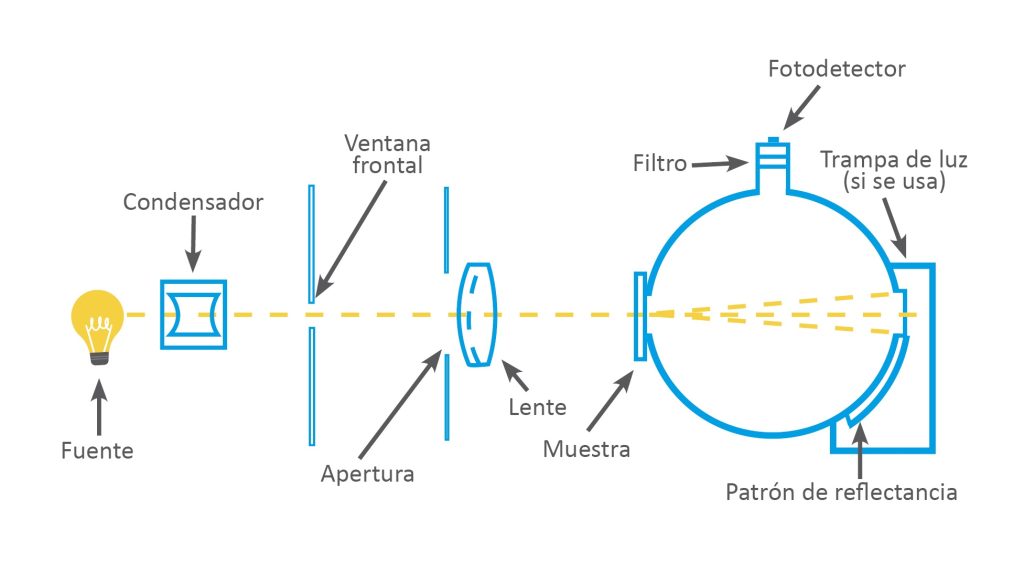
However, ASMT D 1003 explains that although turbidity measurements are commonly made using a hazemeter, an integrating sphere spectrophotometer can be used, provided it meets the geometric and spectral requirements of the standard. For this reason, this standard includes two procedures, one to carry out measurements with a hazemeter, and another to carry them out with a spectrophotometer.
Haze measurement tests
There are several standards that include methods of test for haze measurementIn the following subsections we will talk about the UNE-EN 2155-9, the ASTM D 1003 and ISO 1782.
UNE-EN 2155-9
The Norma UNE-EN 2155-9 According to its title, it refers to 'Aerospace material. Test methods for transparent materials for glazing in aerospace constructions. Determination of turbidity.'
This standard is intended to describe a method for determine turbidity in flat sections of transparent plastic materials, using an apparatus based on an integrating sphere. This integrating sphere is used to collect the transmitted luminous flux.
However, according to the standard, this method is not recommended to determine turbidity, when values greater than 30% are obtained.
The UNE EN 2155-9 standard indicates that the percentage of turbidity is obtained from the formula:
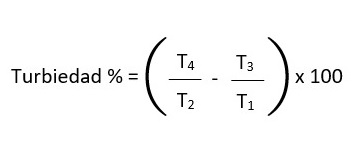
This percentage must be expressed, according to the standard, with an approximation of 0.1%, while the thickness of the specimen must be measured in millimeters with an approximation of 0.02 mm.
ASTM D 1003
The Norma ASTM D 1003, «Standard Test Method for Haze and Luminous Transmittance of Transparent Plastics»It provides two procedures for luminous transmittance measurements and turbidity.
This method covers the evaluation of specific light transmission and wide-angle light scattering properties of planar sections of materials such as essentially transparent plastic.
Regarding the two procedures indicated in the standard, Procedure A uses a hazemeter, while procedure B uses a spectrophotometer.
ISO 14782
Regarding the standard ISO 14782, «Plastics. Determination of haze for transparent materials», specifies a method applicable to the turbidity measurement less than 40%.
In this method, turbidity is determined by an integrating sphere whose efficiency is kept constant by compensation.
The method indicates that four measurements given in the following table must be carried out:
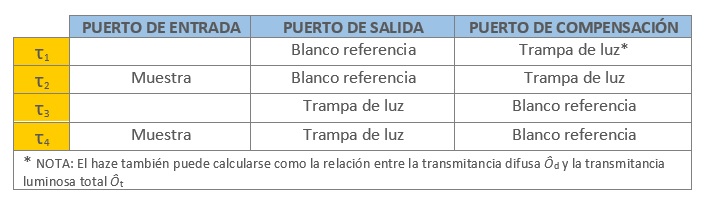
As it happens in the UNE-EN 2155-9, the rule ISO 14782 It also indicates the following formula for calculating haze:
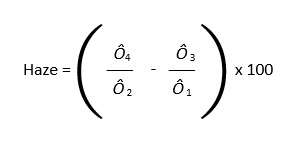
where:
τ1 is the intensity of the incident light.
τ2 is the intensity of the light transmitted by the sample.
τ3 is the intensity of light scattered by the instrument.
τ4 is the intensity of the light scattered by the instrument and the sample.
Calibration and tests in Laboratorios Eyco
Laboratorios Eyco has recently added to its catalog of services the hazemeter calibration.
RANGERange |
UNCERTAINTY (*)-- |
STANDARD/ PROCEDURE-- |
INSTRUMENTS TO CALIBRATEInstruments |
CODECode |
| Haze | ||||
| 0≤Haze≤30 | 1% | ASTM D 1003 UNE-EN 2155-9 ISO 14782 | Hazemeter | A,I |
On the other hand, Eyco performs haze measurement tests according to the Standards UNE-EN 2155-9, ISO 14782 y ASTM D 1003 (method B), for which it has a spectrophotometer with integrating sphere 150mm. The sphere's dimension ensures that the ratio between the sample size and the sphere will always conform to the standard.
FAQ
What is haze or turbidity in transparent materials?
El haze or turbidity It is an optical property that quantifies the percentage of transmitted light that is deflected by more than 2,5 degrees from the incident light beam when passing through a material. This light scattering reduces optical contrast and causes a loss of visual sharpness through plastics, glass, or transparent films.
How does a hazemeter or turbidimeter for plastics work?
Un hazemeter It is a specialized optical instrument consisting of a light source, an integrating sphere, and photometric detectors. The instrument measures both total light transmittance and diffuse transmittance, calculating the haze value as the percentage ratio between scattered light and total transmitted light.
Why is it essential to control haze levels in the industry?
Haze control is crucial for evaluating the optical and aesthetic quality This is used for products where transparency is a priority, such as food packaging or plastic lenses. It ensures manufacturing uniformity and certifies that the material meets market requirements.
What international regulations govern haze measurement tests?
there are several official international standards applied in testing laboratories to ensure reproducible turbidity measurements:
- The ASTM D 1003, the most widely used reference method globally for transparent plastics.
- International standard ISO 14782, specifically for the determination of haze in plastic materials.
- The European standard UNE-EN 2155-9, focused on the evaluation of transparent plastic materials for use in aerospace glazing.
What advantages does conducting haze tests in a specialized laboratory offer?
Entrusting the measurement to a laboratory specializing in optical properties Eyco guarantees maximum reliability. The use of hazemeters calibrated with traceable reference standards and under standardized methodologies ensures precise technical results, ideal for rigorous quality control processes, audits, and research and development.