
Companies have to guarantee the safety of their workers, especially in jobs where the risks are high.
One of the ways to promote safety and protection in certain workplaces is the use of adapted work clothes, since this equipment reduces the risk of accidents and injuries.
Among the different types of work clothes, there is the high visibility protective clothing, regulated by the Standard A EN ISO 20471. This clothing is intended to provide visibility in situations where the risk of not being seen is high. Thus, workers in industry, construction, road agents and road and rail operators use this type of work clothing. In addition, cyclists, pedestrians moving on the road, or people in an emergency situation on the road, to name a few examples, make use of this clothing with the aim that the presence of these users is signaled visually.
The garments subject to this regulation -trousers, overalls, vests and jackets- must meet a series of requirements. These requirements make it possible to guarantee the effectiveness of the materials that stand out for their visibility used in said garments. The efficiency referred to above is defined by the photometric properties of the materials, as well as by the requirements in their minimum areas and their layout (or design), as indicated by the Standard itself. High-visibility clothing must immediately attract visual attention, that is, it must have the property of being conspicuous. The contrast of luminance, color, the design of the garments and their configuration determine the ability to visually attract attention. This is especially important in environments where there are more objects that visually compete with the people who wear this type of clothing.
Table of contents
High-visibility clothing requirements
Among the requirements for high-visibility clothing to meet the Standard A EN ISO 20471, there are those that concern the background material, the fluorescent material and the combined material. On the other hand, the standard also establishes photometric performance requirements for retroreflective material and combined material after physical exposure.
Regarding the requirements that concern the background material, the non-fluorescent material and the combined material, the standard establishes a series of requirements. These requirements refer to:
-Color performance for new materials, color after xenon test. In addition, the standard defines a series of values for the chromaticity coordinates and the luminance factors.
-The color fastness of the background material and all layers of non-fluorescent material after testing. Specifically, color fastness to rubbing, color fastness to sweat, color fastness to washing, dry cleaning, hypochlorite bleaching and hot ironing
-The dimensional variation of the background material and the non-fluorescent material
-The mechanical properties of the background material and the non-fluorescent material. More specifically, tensile strength of woven materials, bursting strength of knitted materials, tensile and tear strength of coated and laminated fabrics
-Physiological requirements. Specifically, resistance to water vapor and thermal resistance.
For its part, with regard to photometric performance requirements for retroreflective material and combined material after physical exposure, the standard establishes a series of retroreflection requirements for new material and retroreflection after testing.
Highg-visibility clothing classes
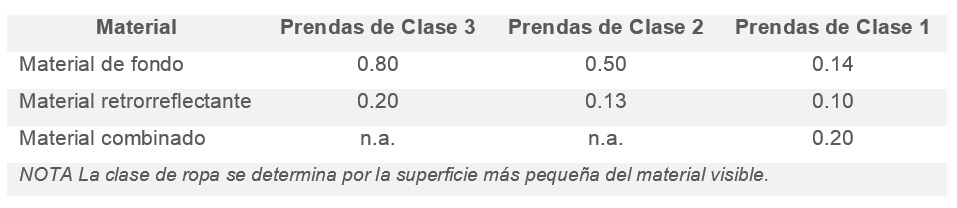
The standard distinguishes three classes of high-visibility protective clothing. It further defines Class 3 as that which provides the highest level of visibility, both day and night, in most rural and urban environments. The different classes of high visibility clothing They are defined taking into account three different minimum areas of retroreflective, fluorescent and/or combined material.
Regarding the design, the Standard specifies a series of minimum surfaces of visible material in m2, depending on whether they are class 1, class 2 or class 3 garments. The following table shows the minimum surfaces required by the UNE EN ISO 20471 Standard:
The importance of carrying out accredited tests
Accredited laboratories to carry out tests on the optical properties of materials offer a guarantee of compliance with the requirements that the Standard A EN ISO 20471 establishes to carry out this type of tests.
The samples taken must be prepared and conditioned adjusting to the size, shape and quantity required in each test method. The conditioning of the sample must be carried out for at least 24 hours with a certain temperature and relative humidity.
After expanding the scope of accreditation, Laboratorios Eyco is accredited by ENAC to perform color coordinate tests on high visibility signaling clothing, following the UNE EN ISO 20471 standard.
With regard to color determination, accredited laboratories use a polychromatic illumination instrument, in the 45/0 illumination and observation geometry. In addition, we use a standard illuminant CIE D65 and a standard 2nd observer, as indicated in the UNE EN ISO 20471 Standard.
The standard also specifies how the sample must be measured. Thus, laboratories accredited by ENAC perform this measurement by measuring a single layer that includes any support or lining used in its manufacture, against a black background with a reflectance of less than 0.004. Once at least four measurements have been taken in four perpendicular directions, the average value must be provided as the test result.
Results of a trial
The following graph and table show the data obtained in a test designed to determine the color coordinates in high-visibility clothing. Specifically, the test was carried out on a yellow vest.
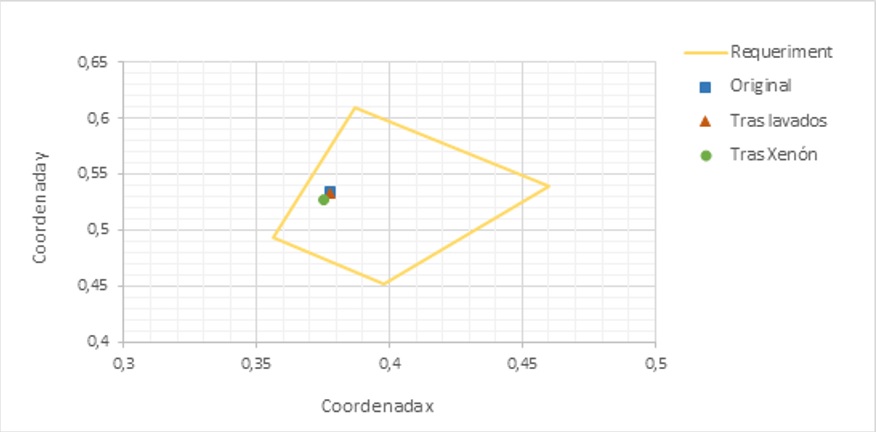
The requirements of the standard are indicated in the graphic by the yellow polygon. In this way, the measured color has to be within the yellow polygon. In this test, the color of the original fabric has been measured, as well as after aging with washing and xenon light.
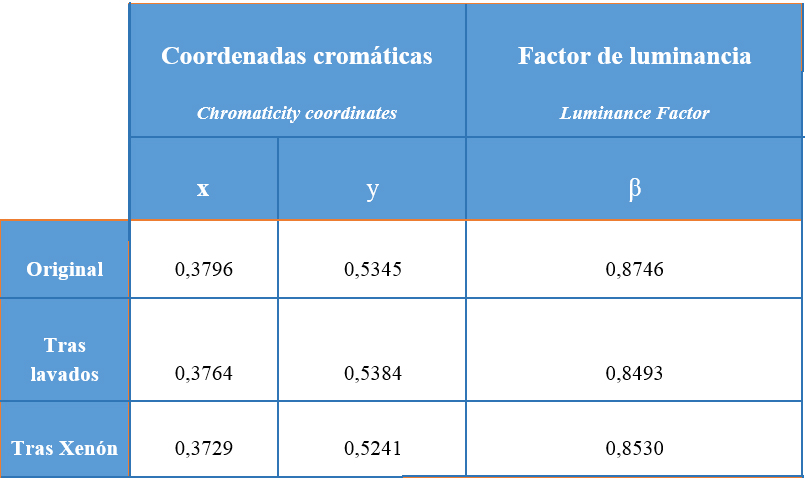
In addition to color determination, the standard details other testing methods, such as the determination of the photometric performance of retroreflection; the retroreflection test after the tests –abrasion, flexing, folding at low temperature, exposure to temperature variations, influence of rain-; or the aging test –washing and dry cleaning.
FAQ
What standard regulates the photometric properties of high-visibility protective clothing?
The international reference standard is the UNE EN ISO 20471 StandardThis standard rigorously specifies the requirements that high-visibility garments intended to visually signal the user's presence in risky situations, both day and night, must meet.
What are the main photometric properties that are evaluated in these garments?
To ensure workplace safety, three fundamental photometric properties must be analyzed: chromatic coordinates (the exact color), the luminance factor (the brightness capacity of the background material) and the coefficient of retroreflection (the efficiency with which the reflective strips return light to its source).
How are the color and luminance of the background material measured?
The color and luminance factor of fluorescent fabrics (typically yellow, orange-red, or high-visibility red) are measured using a spectrophotometer or colorimeter with a specific measurement geometry (generally 45°:0° or 0°:8°). The results are transformed into CIE color space coordinates to verify that they fall within the required legal tolerances.
What is retroreflection and how are reflective materials evaluated?
Retroreflection is the physical property that allows a material to reflect light directly back towards the light source (such as car headlights). It is measured using a retroreflexometer in an optical laboratory, evaluating the coefficient of retroreflected light intensity under different angles of observation and illumination to simulate real night driving conditions.
Why is it necessary to test high-visibility clothing in an expert laboratory like Eyco?
Perform optical tests in Eyco[Company Name], a specialist in photometric properties, ensures maximum accuracy, repeatability, and technical compliance with ISO 20471. This provides manufacturers of personal protective equipment (PPE) and prevention companies with the necessary certificates to certify their products, guaranteeing that they will effectively protect workers' lives.