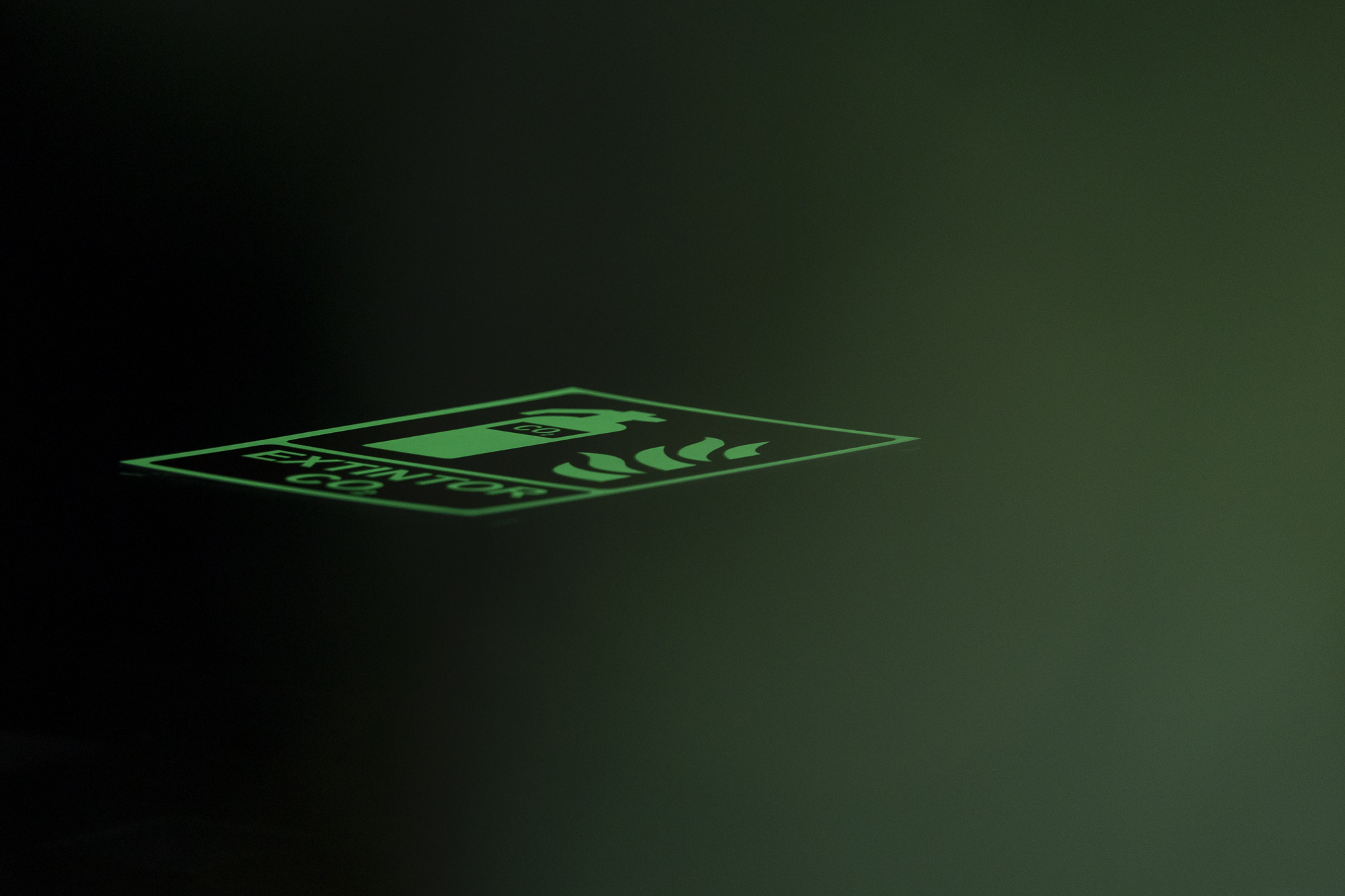
Luminance and fade time
The only accredited laboratory for the evaluation of photoluminescent products.
What are we rehearsing?
Eyco performs the following tests:
- Test accredited by ENAC for the determination of attenuation time and luminance in photoluminescent products and signs, according to the standard UNE 23035-1: 2003. Fire safety. Photoluminescent signage. Part 1: Measurement and rating.
- UNE 23035-1. Fire safety. Photoluminescent signage. Part 1: Measurement and rating.
- ISO 16069. Graphical symbols –Safety signs – Safety way guidance systems (SWGS).
- Determination of luminance, light response under conditions of low stimulation.
- DIN 67510-1: 2009. Phosohorescent pigments and products – Part 1: Measurement and marking at the producer.
- ASTM E2073-10 standard. Standard Test Method for photopic luminance of photoluminescent (phosphorescent) markings.
- ISO 15370. Ships and marine technology-low-location lightling on Passenger ships-Arrangement.
- UNE EN ISO 9227. Determination of luminance and attenuation time before and after corrosion in a salt spray atmosphere.
- UNES EN ISO 2813:2015 standard. Determination of specular brightness at 20º, 60º and 85º
- Artificial aging due to exposure to artificial radiation UNES EN ISO 16474:2014 standard
Luminance and fade time
Luminance is the angular, rectangular and surface density of the luminous flux that falls on, passes through or emerges from a surface following a given direction. It is also defined as the surface density of luminous intensity in a given direction.
For its part, the attenuation time is the time elapsed from the end of the stimulation until the luminance is reduced to 0.3 mcd/m2.
In the field of safety, the regulations for fire protection installations (RIPCI) establishes that photoluminescent signs must comply with the requirements of the Standard UNE 23035.
This Standard (specifically, UNE 23035-4) determines the minimum luminance and attenuation time values that photoluminescent signs must meet to be classified as Type A or Type B. In addition, the Standard indicates the test procedure that must be followed in order to measure the luminance and calculate the attenuation time.
In this way, according to the UNE 23035-4 Standard, the following values are established:
| Category of photoluminescent signals | ||
| Type A | type B | |
| Luminance at 10 min | ≥ 210mcd/m2 | ≥ 40mcd/m2 |
| Luminance at 60 min | ≥ 29mcd/m2 | ≥ 5.6mcd/m2 |
| Fading time (min) | ≥3000min | ≥800min |
Furthermore, it is necessary to perform accelerated aging tests using salt spray on the photoluminescent signs, as established by Standard UNE 23035-4. These tests must determine the attenuation time and luminance. To carry out this evaluation, the signs will be assessed both before and after the corrosion test in artificial atmospheres. As for the salt spray tests, they must be carried out following the guidelines of the ISO 9227It is important to note that the luminance and attenuation time values obtained after the aging test cannot decrease by more than 5% compared to the values obtained before the test.
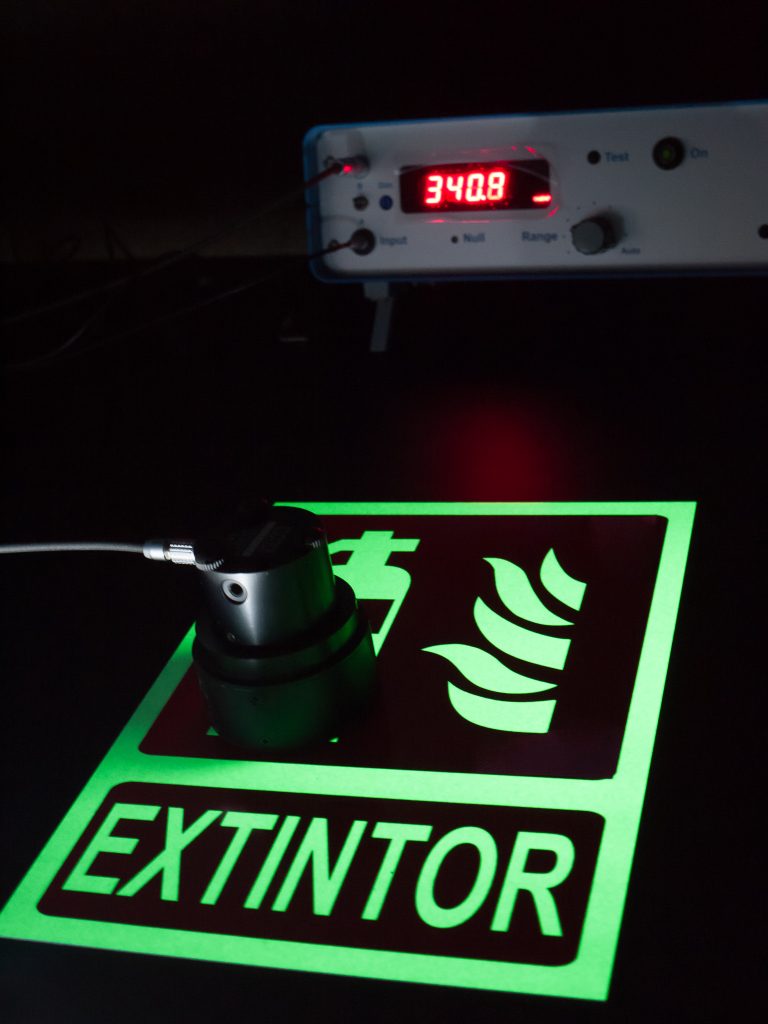
The tests on photoluminescent products are based on the measurement of said products after having subjected them to excitation with a specific lighting for a certain time. After cessation of stimulation, the luminance that the product emits during a given period of time has to be measured. From these measurements it is possible to calculate the attenuation time by means of extrapolations.
The different standards that regulate photoluminescent signaling establish the excitation or stimulation conditions, as well as the measurement conditions and the calculation of the attenuation time.
The result
Each test performed by Eyco is documented in a technical report that includes:
- The identification and description of the sample
- The standardized methods applied
- Test conditions
- The equipment used
- The results obtained
- Measurement uncertainty
The data is presented in a clear and traceable manner, meeting the necessary quality requirements.