Color is a key parameter to accurately assess wine quality
In wine analysis, one of the key aspects to assess its quality is its colour. Accurate measurement of this parameter not only helps to visually classify the wine, but is also essential to understand its chemical composition and its evolution over time.
In order to measure it objectively and reproducibly, it is essential to use optical laboratory instrumentation, in particular the UV-Vis spectrophotometersIn this post, we discuss its application in the wine industry and the methods and indices used in its measurements.
Why is it important to measure the color of wine?
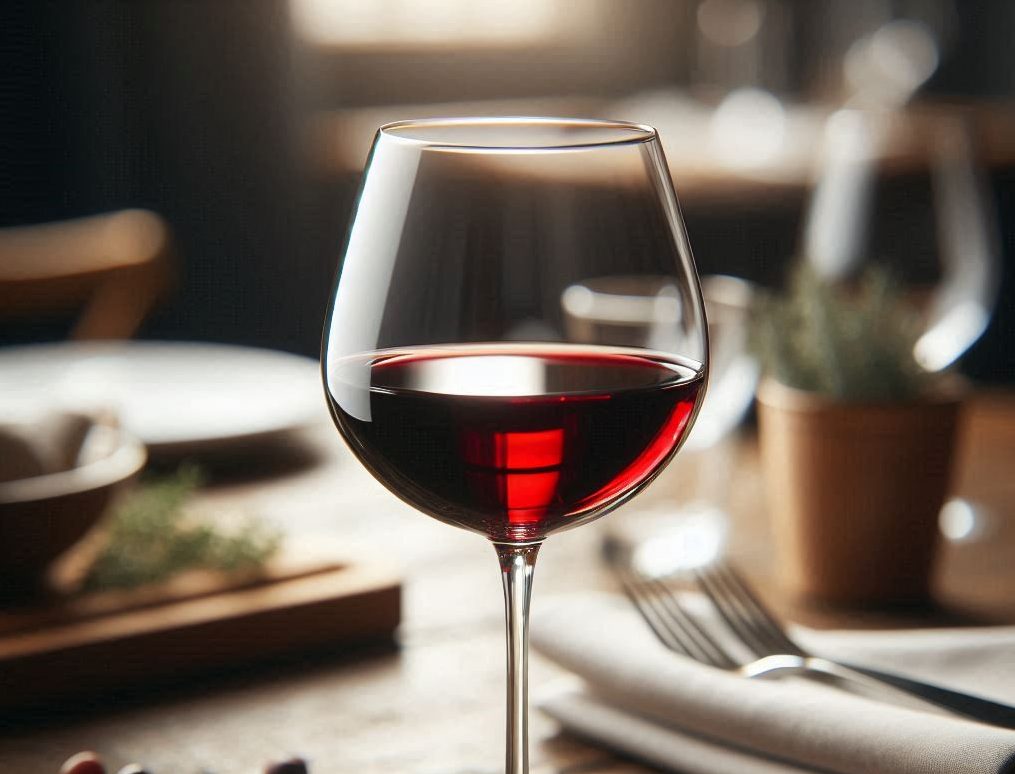
The color of a wine provides information about its origin, its aging process, and the type of grape used. In red wines, for example, the color can vary from a deep red to a brick red as the wine ages. In white wines, the hue can range from a pale yellow to a golden hue. These color changes are linked to oxidation, the polymerization of anthocyanins (pigments present in grapes), and other chemical processes during fermentation and aging.
Subjective color assessment is useful, but variations in human perception can lead to errors. This is why, for decades, UV-Vis spectrophotometry It has become the main technique for objectively quantifying wine color, allowing results to be compared between wineries, batches, and processes.
UV-Vis Spectrophotometry: A Rigorous Approach
Spectrophotometric analysis is based on the absorbance measurement of wine at specific wavelengths, both in the ultraviolet (UV) and visible (VIS) spectrums. These measurements allow the color to be characterized from a physical perspective.
For example, the absorbance at 280 nm In ultraviolet light, it is used to estimate the concentration of phenolic compounds, which contribute to the color intensity and sensory characteristics of wine.
On the other hand, wavelengths in the visible range, such as 420 nm, 520 nm and 620 nm, are used to measure the different shades of color in red, white, and rosé wines. These lengths are directly linked to the intensity and hue of the observed color.
Official methods of measuring wine colour
In Spain, the official method for measuring the color of wine follows the recommendations of the Office Internationale de la Vigne et du Vin (OIV), as stipulated in the State official newsletter out of 1981. Based on the method of Hardy selected coordinates, allows to determine the chromatic properties of wine by means of spectrophotometric measurements at selected wavelengths. This method is based on the system of the International Commission of l'Eclairage (CIE), which uses a illuminant C, corresponding to a diffuse light similar to that produced by a cloudy sky.
As explained by Department of Chemistry of the University of La RiojaThis procedure introduces three chromatic characteristics of the wine:
- Relative luminosity (Y): Expressed as a percentage, where Y = 0% represents absolute black, and Y = 100% represents a colorless liquid.
- Dominant wavelength: It corresponds to the hue of the color and is determined graphically in a chromatic diagram.
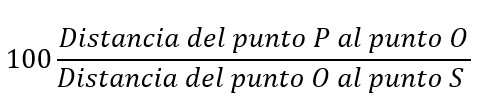
- Pureza: Purity is calculated by determining the relative distance from point P, which represents the colour of the wine examined, and from point S, which corresponds to the locus of the spectrum, to point O, which represents the illuminant. Purity is expressed as a percentage by the ratio:
Steps of the official method
The official procedure established in Spain for wine color analysis provides guidelines on how to carry out spectrophotometric measurements and calculate tristimulus values.
The procedure indicates that the transmittance values corresponding to the same sample should not show differences of 0,005 and when the scale of the UV-Vis spectrophotometer is graduated in transmittance values multiplied by 100, there should be no difference greater than 0,5.
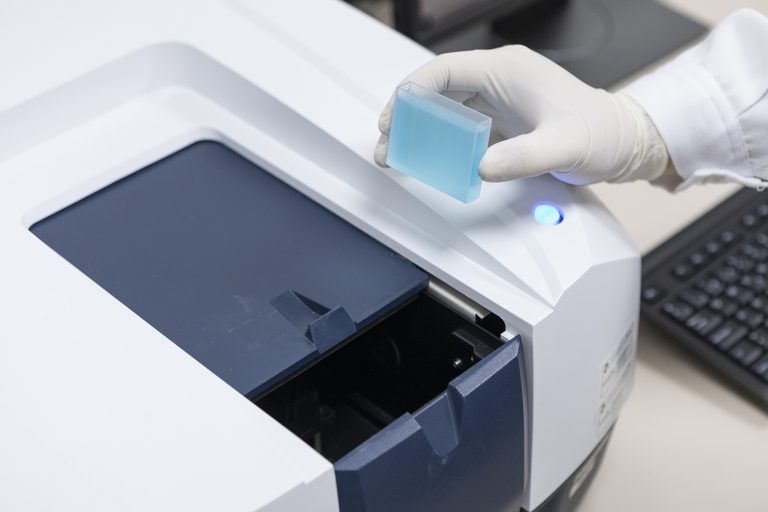
With regards to spectrophotometric measurement, the transmittances of the wine are determined at the wavelengths of 625nm, 550nm, 495nm and 445nm, using quartz or glass cuvettes with parallel walls and a refractive index no greater than 1.5. The internal thickness, denoted as "b", is measured in centimeters and must have an accuracy of ± 0.002 b. Depending on the color intensity of the sample, the cuvettes will be selected so that the absorbance A is between 0.3 and 0.7 (transmittance 0.5-0.2).
On the other hand, with the transmittances obtained the tristimulus values X, Y y Z, which are translated into chromatic coordinates x e yThese coordinates are used to represent the color of the wine on the CIE color diagram.
Tristimulus values are calculated using the following expressions:
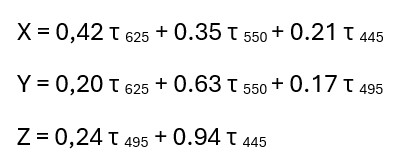
The coordinates are then calculated. x e y using these formulas:
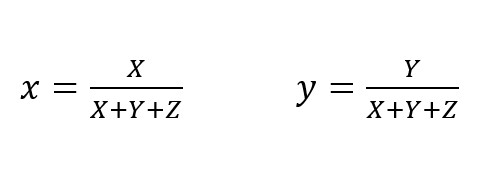
The representative point of the wine color on the CIE chromatic diagram is represented in a three-dimensional space whose coordinate axes are: luminosity Y expressed as a percentage, and the chromatic coordinates x e y.
Colorimetric indices: Sudraud, Glories and OIV rapid method
It should be noted that according to Negueruela, Echávarri, Ayala and Lomas in their article "Colorimetry in Wines" (1995), winemakers disagree with the official method due to its difficulties and the lack of relationship between the coordinates x e y and the psychological attributes of wine colour, such as hue, saturation and clarity. They therefore prefer to use measures such as purity and dominant wavelength, although they often resort to intensity and hue indices because of their speed and ease of calculation. These indices are useful for measuring colour evolution during winemaking, but, as the authors point out, they have no relation to the official CIE colour determination methods.
Thus, for the rapid evaluation of wines, various indices are used that allow a practical control of the evolution of color during aging or maturation. Among them, those proposed by Suraud, recognized among the official methods in Spain (BOE 1977):
- Color intensity: It is calculated as the sum of the absorbances at 420 nm y 520 nm, which gives an idea of the amount of colouring matter in the wine.
- Tonality: It is the relationship between the absorbances at 420 nm y 520 nm, and provides information about the color hue.
Another method officially recognized in Spain is the rapid method of International Office of Vine and Wine, described by Tanner and BrunnerThis method defines "color intensity" like Sudraud, but expresses "hue" in degrees.
On the other hand, the method proposed by Glories add the absorbance to 620 nm to calculate a coloring intensity more complete, covering the widest ranges of colours in the visible spectrum. Glories also introduced the dA index (%), which represents the degree of red colour in the wine, useful for differentiating between wines with bright red tones and those closer to brick red. Thus, as Negueruela et al. (1995) explain, Glories proposes a new 'colour intensity' which corresponds to:

Negueruelas et al. (1985) also detail the expression defined by Glories:

So if the wine has a bright red color, dA(%) is high, between 60 and 80%, while if the wine has a brick red color, dA(%) is less than 40%.
These indexes are highly valued for their speed of calculation and ability to track color evolution during winemaking, aging or technical treatments.
Optical instrumentation for oenology
To ensure the reliability of these colorimetric analyses, it is essential that the spectrophotometers used are correctly functioning. calibratedIn both oenological laboratories and wine industries, metrological maintenance of this equipment is key to ensuring that the data obtained accurately reflects the product's reality.
The UV-Vis spectrophotometers They offer several advantages over visual color assessment:
- ObjectivitySpectrophotometry provides accurate and quantifiable data, eliminating subjectivity.
- repeatabilitySpectrophotometric measurements can be repeated with high accuracy, ensuring consistency in results.
- SpeedColor analysis with UV-Vis spectrophotometry allows for rapid control at different stages of wine production.
In addition to color, other optical parameters such as refractive index —measured with Refractometers— are essential in controlling processes such as must maturation (using Brix levels) or monitoring fermentation. In both cases, metrological traceability This is the foundation for ensuring the reliability of the results. OIML (International Organization of Legal Metrology) establishes in recommendation OIML/TC17/SC2/N3 (Automated Refractometers. Methods and means of verification) methods and means for the verification of refractometers.
La Refractometry in oenology uses scales different for the direct determination of probable alcohol (% V/V) and the concentration of invert sugar (% w/w), as well as scales based on the density and concentration of soluble solids such as Brix degrees (°Bx), Baumé (ºBé), Oechsle (ºOe) y KMW/Babo to assess the ripeness of the grapes and predict the final alcoholic level.
Eyco
Eyco offers calibration services UV-Vis spectrophotometers for the wine industry. In addition, Eyco also calibrates other equipment such as Refractometers, which, as we have said, are used to measure the concentration of sugar in must and wine. Eyco has ENAC accreditation ENAC, ensuring that its services meet the highest standards of quality and precision, backed by international standards.
FAQ
Why is it important to measure the color of wine?
El wine color It is one of the main indicators of quality, age, and state of preservation. Its measurement allows for the evaluation of the wine's evolution during the production and aging process, the detection of possible alterations, and the assurance that the product maintains the characteristics expected by the consumer.
What is UV-Vis spectrophotometry applied to wine analysis?
La UV-Vis spectrophotometry It is an analytical technique that measures how a liquid absorbs light at different wavelengths. In the case of wine, it allows for the objective quantification of its hues and color intensity by measuring absorbance at specific wavelengths of the visible spectrum.
What wavelengths are used to analyze the color of wine?
They are commonly used specific wavelengths of the visible spectrum to determine the intensity and hue of the wine. These measurements allow the calculation of parameters such as color intensity or shade, which are fundamental for evaluating red, rosé, and white wines objectively and reproducibly.
What official methods exist for measuring the color of wine?
Several standardized methods Used in oenological laboratories to measure the color of wine. Among the best known are:
- The color system CIE L*a*b*, which describes color using three-dimensional chromatic coordinates.
- The method of Sudraud, used to determine color intensity by means of absorbances at 420, 520 and 620 nm.
- The indices of Glories, which analyze the contribution of different phenolic compounds and polymerized pigments.
- The methods defined by the OIV (International Organisation of Vine and Wine).
Why have wine color measured in an accredited laboratory?
Perform the analysis in a laboratory accredited by ENACAs Eyco Laboratories, we guarantee reliable, traceable, and repeatable results. Accreditation ensures that the analytical methods used meet international standards and that the equipment is properly calibrated, providing accurate data for wineries, research centers, and oenological quality control.